The Lady of Shalott
John William Waterhouse

📌 Pin it
Alfred Tennyson's 1832 ballad tells of a lady cursed to see the world only in a mirror's reflection; the moment she turns to look directly at Sir Lancelot, the mirror cracks and she knows the curse is upon her. Waterhouse paints the instant after: the lady has risen from her loom, three candles guttering beside her, and she looses the boat that will carry her down to Camelot to die.
Waterhouse was not strictly a Pre-Raphaelite, but he inherited their world — medieval legend, literary subjects, and heroines of doomed beauty. He would return to the Shalott story twice more, in 1894 and 1915, but the 1888 version, shown at the Royal Academy that year, is the one the world remembers. Its tapestry, trailing from the boat into the water, is painted with an almost textile realism.
Few Victorian paintings have been reproduced so relentlessly — on prints, posters, book covers and album art for over a century. It did for Tennyson's poem what the poem did for Arthurian legend: made it unforgettable.
Frequently asked
What is the story of the Lady of Shalott?
In Tennyson's poem, a lady is cursed to see the world only in a mirror's reflection. When she turns to look directly at Sir Lancelot riding to Camelot, the mirror cracks — she knows the curse is on her, and she floats down the river to her death.
How many versions of the Lady of Shalott did Waterhouse paint?
Three: the famous 1888 version at Tate Britain, a second in 1894, and a final one in 1915.
Where is the 1888 Lady of Shalott?
Tate Britain, London.
Why it matters today
The painting made Tennyson's heroine the archetypal doomed romantic heroine of the visual age — endlessly copied, parodied and reimagined ever since.
More in Art & Painters
All →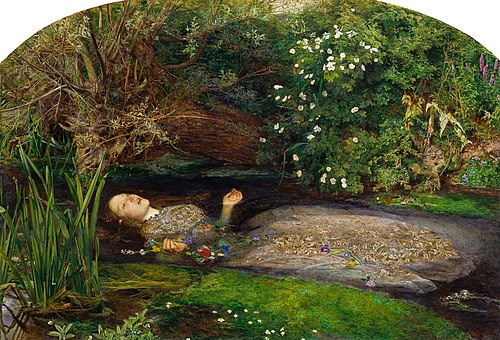
Ophelia
A drowned Shakespearean heroine, painted leaf by leaf on a Surrey riverbank — the image that made the Pre-Raphaelites immortal.

Flaming June
A sleeping woman wrapped in translucent orange silk — the single most famous image of the Aesthetic movement, lost and found again.

Beata Beatrix
Rossetti's memorial to his dead wife, caught at the instant her soul takes flight — love, grief and laudanum in a single image.