Architecture & Design
The buildings that made the Victorian age visible — a glass palace that held the world, a Gothic parliament, terracotta cathedrals of nature and design, and the cemetery Londoners visit like a park.

The Crystal Palace
A gardener's glasshouse scaled up to hold the world — 1,848 feet of iron and glass, six million visitors in a single summer, then a single night of fire.
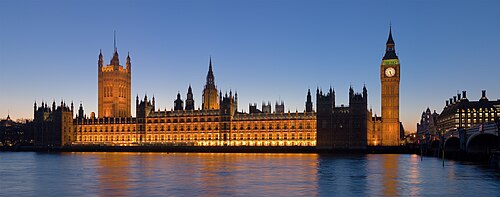
The Houses of Parliament
Rebuilt from the ashes of the 1834 fire, the Palace of Westminster made Gothic Revival the face of British democracy — and gave London its most famous silhouette.

The Albert Memorial
A 176-foot Gothic shrine in Kensington Gardens — Queen Victoria's monument to the husband she lost, crowded with 169 sculpted geniuses and four continents.
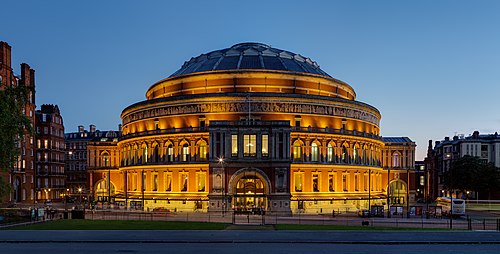
The Royal Albert Hall
An elliptical amphitheatre of red brick and terracotta, opened by a grieving queen in her husband's memory — and home to the Proms every summer since 1941.

The Natural History Museum
A Romanesque palace in terracotta, every tile moulded with living and extinct creatures — the building itself is a museum of natural history before you reach a single gallery.

Manchester Town Hall
Fourteen million bricks and a 280-foot clock tower: the proudest town hall in Britain, built by the city that clothed the world — and still the benchmark for civic Gothic.

Highgate Cemetery
The most atmospheric of London's Magnificent Seven — Egyptian Avenue, the Circle of Lebanon, catacombs under a cedar, and 170,000 souls including Karl Marx.

The Victoria and Albert Museum
Born from the Great Exhibition as a museum to teach manufacturers good taste — now the world's largest museum of applied arts, with 2.8 million objects across 145 galleries.

The Royal Albert Dock
The world's first fireproof warehouse system — five storeys of cast iron, brick and stone around a Mersey basin, opened by Prince Albert and reborn as Liverpool's cultural quarter.

Leadenhall Market
A market has traded on this spot since Roman London — and Sir Horace Jones's wrought-iron and glass arcade of 1881, all dragons and painted ribs, is still the City's prettiest roof.

The Royal Courts of Justice
The last great secular building of the Gothic Revival — George Edmund Street's grey-stone palace on the Strand, with a Great Hall 238 feet long and more than a thousand rooms.

St George's Hall, Liverpool
A concert hall and a courthouse in a single Neoclassical temple — won by a 25-year-old, finished after his death, and floored with 30,000 Minton tiles almost no one ever sees.

Westminster Cathedral
London's great Catholic cathedral is not Gothic at all — it is a red-brick Byzantine basilica with a 284-foot campanile, built without steel and consecrated only when its debts were paid.

Truro Cathedral
The first cathedral built on a new site in England since Salisbury in 1220 — three Cornish granite spires, thirty years in the making, and the birthplace of Nine Lessons and Carols.

Kelvingrove Art Gallery and Museum
Paid for by one exhibition and opened for another — a red sandstone palace that opened in the year Victoria died, and still holds Scotland's favourite painting.

Cardiff Castle
A Roman fort inside a Norman castle inside a Victorian dream — the richest man in Britain let William Burges turn a ruin into the most opulent Gothic fantasy in the country.

The Savoy Theatre
Richard D'Oyly Carte's theatre for Gilbert and Sullivan — the first public building in the world lit entirely by electricity, with 1,200 Swan lamps glowing where gas had always ruled.

The Foreign Office, Whitehall
George Gilbert Scott's Italian palazzo for the departments that ran an empire — Gothic overruled by a prime minister, with Wyatt's marble Durbar Court at its heart.

Crossness Pumping Station
A sewage pumping station dressed as a cathedral — Bazalgette's ornate ironwork engine house at the end of the sewers that saved London from the Great Stink.

Blackpool Tower
A Lancashire answer to the Eiffel Tower — 518 feet of steel rising out of a circus and a ballroom, the tallest structure in the British Empire when it opened.

Glasgow City Chambers
The palace Glasgow built for itself at the peak of its wealth — William Young's Italian Renaissance town hall, with the largest marble staircase in Western Europe.

The John Rylands Library
Enriqueta Rylands' neo-Gothic memorial to her husband — a church-like library on Deansgate, opened on the first day of the twentieth century.

Waddesdon Manor
Baron Ferdinand de Rothschild's French Renaissance fantasy — a Loire château raised on a levelled hill to hold one of Europe's great collections.

The Scott Monument
The largest monument to a writer in the world — a 200-foot Gothic spire designed by a self-taught joiner who died before it was finished.