The Royal Albert Hall
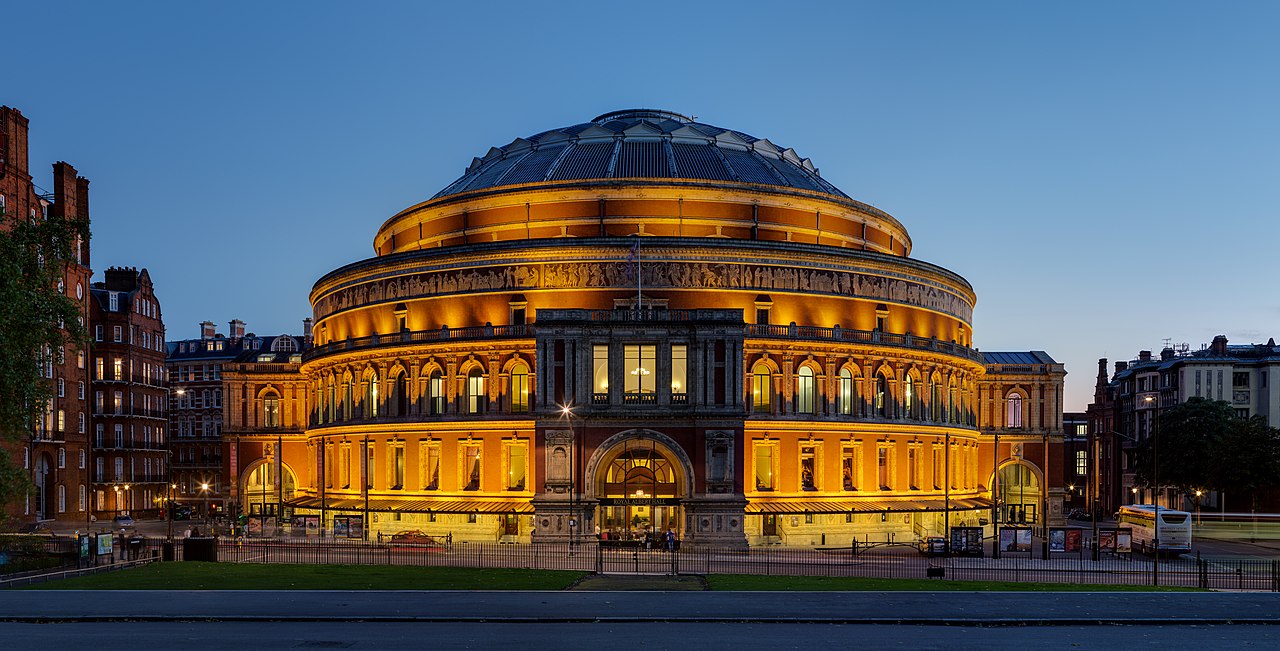
Fowke & Scott's hall of arts and sciences, 1871
📌 Pin it
The hall was the centrepiece of Albertopolis, Prince Albert's great cultural quarter in South Kensington, built on land bought with the profits of the Great Exhibition of 1851. It was first planned as the Central Hall of Arts and Sciences, but when Queen Victoria laid the foundation stone on 20 May 1867 she renamed it for her husband, dead six years. It was designed by two Royal Engineers, Captain Francis Fowke and Major-General Henry Y. D. Scott — Fowke died suddenly in 1865, and Scott completed the work — and built by Lucas Brothers.
Victoria opened the hall on 29 March 1871, before an audience of some 8,000 dignitaries, and the first concert followed on 1 May: Arthur Sullivan's cantata On Shore and Sea. The hall is an ellipse 83 metres by 72 metres, roofed by a great glass-and-iron dome 41 metres high, with seating for 5,272. Its acoustics were notorious from the start — a famous echo haunted the dome — until mushroom-shaped fibreglass diffusers were hung from the ceiling after tests in the late 1960s, and the hall finally sounded as good as it looked.
The hall's defining resident arrived in 1941, when the Queen's Hall was destroyed in the Blitz and the Proms — Henry Wood's promenade concerts, founded in 1895 — moved to South Kensington. They have been held here every summer since, more than 70 concerts a season, ending in the Last Night. The hall has also hosted Eurovision in 1968, boxing, ballet, rock and the Royal Choral Society, which has sung here since 1872 — and it remains a charity held in trust for the nation, receiving no public funding.
Frequently asked
Why is it called the Royal Albert Hall?
Queen Victoria renamed it when she laid the foundation stone in 1867, in memory of Prince Albert, who had died six years earlier. It was originally to be called the Central Hall of Arts and Sciences.
What are the mushrooms on the ceiling?
Fibreglass acoustic diffusers, hung in the late 1960s after years of tests. The hall's great dome produced a notorious echo, and the mushroom shapes scatter the sound so the music reaches the audience cleanly.
When did the Proms move to the Albert Hall?
In 1941, after the Queen's Hall on Langham Place — the Proms' home since their founding in 1895 — was destroyed by an incendiary bomb in the Blitz. The Proms have been held at the hall every summer since.
Why it matters today
The hall made the great concert hall a national living room — and the Proms' formula of cheap standing tickets, nightly concerts and a season for everyone became the model for democratic classical music around the world.
More in Architecture & Design
All →
The Crystal Palace
A gardener's glasshouse scaled up to hold the world — 1,848 feet of iron and glass, six million visitors in a single summer, then a single night of fire.
The Houses of Parliament
Rebuilt from the ashes of the 1834 fire, the Palace of Westminster made Gothic Revival the face of British democracy — and gave London its most famous silhouette.

The Albert Memorial
A 176-foot Gothic shrine in Kensington Gardens — Queen Victoria's monument to the husband she lost, crowded with 169 sculpted geniuses and four continents.