The Albert Memorial
Scott's gilded canopy, 1872

📌 Pin it
When Prince Albert died of typhoid in December 1861, Queen Victoria set out to build him a monument unlike any other — and she paid for it, in part, by public subscription. Designs by Philip Charles Hardwick and George Gilbert Scott were put before her in February 1863, and she chose Scott, the Gothic Revival architect of St Pancras station and the Foreign Office. Construction began in 1864, and the memorial was opened by the Queen in July 1872, at a total cost of £120,000.
The memorial takes the form of a Gothic ciborium — the canopy over a church's high altar — scaled up to 176 feet tall. Beneath it sits a 14-foot gilded bronze statue of Albert, begun by John Henry Foley and completed by Thomas Brock after Foley's death, holding the catalogue of the Great Exhibition of 1851. Around the podium runs the Frieze of Parnassus, 210 feet of sculpture depicting 169 composers, architects, poets, painters and sculptors — musicians and poets on the south side, painters on the east, sculptors on the west, architects on the north — carved by Henry Hugh Armstead and John Birnie Philip. Only one of the 169 is a woman: Nitocris, a female pharaoh of ancient Egypt.
Every surface carries a programme: four groups at the corners celebrate the industrial arts — agriculture, commerce, engineering and manufacturing — while four more represent the continents, each with its animal: Europe with a bull, Asia with an elephant, Africa with a camel, the Americas with a bison. Eight statues personify the sciences, eight more the virtues, and mosaics by Clayton and Bell, made by Salviati of Venice, cover the canopy. The memorial faces the Royal Albert Hall across Kensington Gore, the two buildings standing as a pair: one a monument to grief, the other a celebration of the arts Albert championed.
Frequently asked
Why is the Albert Memorial so over the top?
Because it is a Victorian monument to grief and to empire at once: Victoria wanted a shrine to her husband, and Scott turned it into an encyclopaedia of everything Albert valued — the arts, the sciences, industry and the four continents of the British world.
What is the Frieze of Parnassus?
A 210-foot band of sculpture around the memorial's podium, named after the mountain sacred to the Muses. It shows 169 great figures of art and learning — Shakespeare, Chaucer, Turner, Wren and Scott himself among them — grouped by discipline on the four sides.
Why is Albert holding a book?
It is the catalogue of the Great Exhibition of 1851, the triumph Albert organised and the event that made him the public face of Victorian progress.
Why it matters today
The memorial made the public monument a biography in stone — every civic memorial that followed borrowed its language of allegory, industry and empire, and its Frieze of Parnassus fixed the canon of great artists that Britain still teaches.
More in Architecture & Design
All →
The Crystal Palace
A gardener's glasshouse scaled up to hold the world — 1,848 feet of iron and glass, six million visitors in a single summer, then a single night of fire.
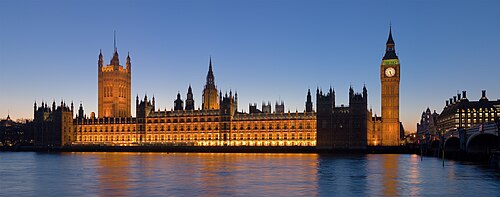
The Houses of Parliament
Rebuilt from the ashes of the 1834 fire, the Palace of Westminster made Gothic Revival the face of British democracy — and gave London its most famous silhouette.
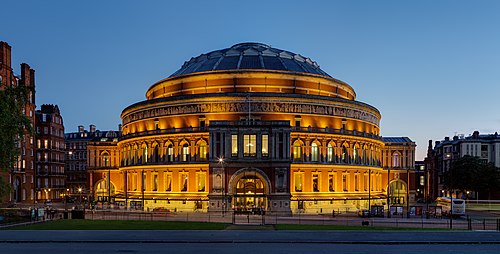
The Royal Albert Hall
An elliptical amphitheatre of red brick and terracotta, opened by a grieving queen in her husband's memory — and home to the Proms every summer since 1941.