The Foreign Office, Whitehall
Scott's palace for the empire's clerks, 1861–75

📌 Pin it
By the 1850s the British government had outgrown its offices: the Foreign Office, founded in 1782, still worked out of makeshift rooms, and the empire it administered was larger than ever. A competition was launched in 1856, and George Gilbert Scott — the great Gothic revivalist — entered a Gothic design. He came third. Then Lord Palmerston, the prime minister, intervened: the building must be Italian Renaissance, not Gothic, to impress foreign visitors. Scott swallowed his principles, redrew the whole thing in a classical palazzo manner, and won the commission.
Construction began in 1861, and the first stage — the Foreign Office and the India Office — was completed in 1868, with the Home and Colonial Office ranges following in 1875. Scott designed the stone facades and the Foreign Office interiors, while Matthew Digby Wyatt, surveyor to the India Office, designed its interiors, including the Durbar Court: a courtyard of three storeys of arcades in Doric, Ionic and Corinthian orders, floored in Greek, Sicilian and Belgian marble. Inside, the Grand Staircase and the Locarno Suite were meant to be, as Scott put it, "a kind of national palace or drawing room for the nation".
After the war the grand rooms were carved up with false ceilings and plasterboard, and in the 1960s the plan was to knock the whole building down. A public outcry saved it; it was Grade I listed and painstakingly restored over decades into the 1990s. It remains the working home of the Foreign, Commonwealth and Development Office — the same departments, in the same palace, that Scott built for them.
Frequently asked
Why isn't the Foreign Office Gothic, like Scott's other buildings?
Because Lord Palmerston ordered it. Scott, the century's leading Gothic architect, submitted a Gothic design and came third in the 1856 competition; Palmerston then insisted the government offices be built in a classical, Italian Renaissance style, and Scott redrew the whole building to suit.
What is the Durbar Court?
It is the great courtyard at the centre of the former India Office, designed by Matthew Digby Wyatt, with three storeys of granite arcades and a marble floor. "Durbar" is a Persian word for a ruler's court, and the name stuck after Edward VII's coronation celebrations were held there in 1902.
Can you visit the Foreign Office?
It is a working government building, but it opens to the public for Open House London and occasional guided tours, when visitors can see the Grand Staircase, the Locarno Suite and the Durbar Court.
Why it matters today
Whitehall's great palace-office set the template for government buildings across the empire — and its near-demolition in the 1960s helped make the case for listing and saving Victorian civic architecture at all.
More in Architecture & Design
All →
The Crystal Palace
A gardener's glasshouse scaled up to hold the world — 1,848 feet of iron and glass, six million visitors in a single summer, then a single night of fire.
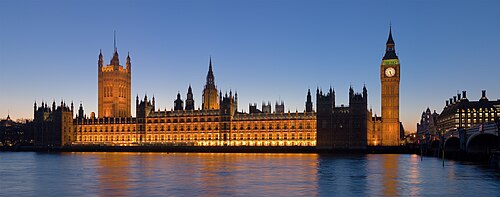
The Houses of Parliament
Rebuilt from the ashes of the 1834 fire, the Palace of Westminster made Gothic Revival the face of British democracy — and gave London its most famous silhouette.

The Albert Memorial
A 176-foot Gothic shrine in Kensington Gardens — Queen Victoria's monument to the husband she lost, crowded with 169 sculpted geniuses and four continents.