Westminster Cathedral
Bentley's Byzantine cathedral, 1903

📌 Pin it
For three centuries after the Reformation, English Catholics had no cathedral in London at all. The site on Ashley Place — once the Tothill Fields House of Correction — was bought in 1885, but two attempts to build on it failed, one under Henry Clutton in 1867 and one under Baron von Herstel in 1892. Then Cardinal Vaughan appointed John Francis Bentley, who persuaded him of something unexpected: the new cathedral should not be Gothic, like every other Victorian church, but Byzantine. The foundation stone was laid on 29 June 1895, and Bentley's building rose in red brick with Portland stone bandings, its three great saucer domes and 284-foot campanile standing out against the grey Gothic of Westminster.
Bentley built almost entirely in brick, without steel reinforcement — a deliberate return to the construction of the early Christian basilicas. The nave is 70 metres long and 18 metres wide, an uninterrupted space meant to be gradually clothed in marble and mosaic, Byzantine fashion, over generations. Neither of the men who began it saw it finished: Bentley died in 1902, and Cardinal Vaughan died on 19 June 1903, his Requiem Mass one of the first liturgies in the new building. The cathedral opened in 1903, and Edward Elgar had conducted his Dream of Gerontius there the year before — but it was not consecrated until 28 June 1910, because Catholic law required the building debt to be cleared first.
The interior is still, famously, unfinished — the mosaics and marbles Bentley planned are added a little at a time, more than a century on. What is complete is the statement: the largest Catholic church in England and Wales, the mother church of the Catholic community, standing a mile from Westminster Abbey and utterly unlike it. Sir John Betjeman called it a masterpiece, and its striped brick campanile — climbable, with a lift and a view across London — remains one of the city's most distinctive landmarks.
Frequently asked
Why isn't Westminster Cathedral Gothic?
Its architect, John Francis Bentley, wanted Gothic but persuaded Cardinal Vaughan that Byzantine suited a Catholic cathedral better — it recalled the early Christian church before the split with the East, and brick was cheaper and more honest than stone Gothic. The result is unique among London's great churches.
Is Westminster Cathedral finished?
Not quite. Bentley designed the interior to be gradually covered in marble and mosaic, and that work continues more than a century after the building opened in 1903 — the decoration was deliberately left to future generations, funded as money allowed.
How is Westminster Cathedral different from Westminster Abbey?
The Abbey is Anglican and the coronation church of the monarch; the Cathedral is Roman Catholic and the seat of the Archbishop of Westminster. They stand a mile apart and could hardly look more different — the Abbey is medieval Gothic in stone, the Cathedral is Victorian Byzantine in red brick.
Why it matters today
Westminster Cathedral revived Byzantine architecture in Britain and gave English Catholicism its mother church — its brick domes and campanile proved that a great cathedral need not be Gothic, and its unfinished interior made the building itself a century-long work of devotion.
More in Architecture & Design
All →
The Crystal Palace
A gardener's glasshouse scaled up to hold the world — 1,848 feet of iron and glass, six million visitors in a single summer, then a single night of fire.
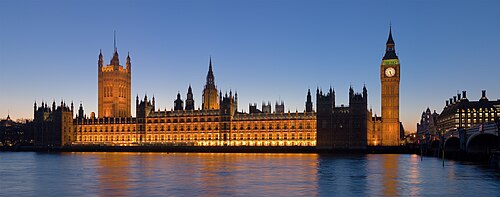
The Houses of Parliament
Rebuilt from the ashes of the 1834 fire, the Palace of Westminster made Gothic Revival the face of British democracy — and gave London its most famous silhouette.

The Albert Memorial
A 176-foot Gothic shrine in Kensington Gardens — Queen Victoria's monument to the husband she lost, crowded with 169 sculpted geniuses and four continents.