Truro Cathedral
Pearson's Cornish cathedral, 1910

📌 Pin it
When the Diocese of Truro was created in 1876, Cornwall got its own bishop for the first time since the Middle Ages — and the first bishop, Edward White Benson, set out at once to build a cathedral. He chose John Loughborough Pearson, the leading Gothic Revival architect of the day. The foundation stones were laid on 20 May 1880 by the Duke of Cornwall, the future Edward VII, on the site of the old parish church of St Mary in the crowded city centre. Pearson kept the medieval church's south aisle, with its granite walls and wagon roof, and built his cathedral around it — the old aisle survives today as St Mary's Aisle, tucked into the great new church.
It was an enormous undertaking: the first Anglican cathedral built on a new site in England since Salisbury in 1220. The choir, transepts and baptistery were finished and consecrated in 1887 — and then the money ran out. Work stopped for eleven years while funds were raised, and Pearson himself died in 1897, never seeing his cathedral complete. His son Frank Loughborough Pearson took over and finished it to his father's designs: the central tower by 1905 and the two western towers in 1910, thirty years after the work began. Three spires rise over Truro — the central one 250 feet high, the western pair 200 feet — built of Cornish granite outside, with Bath and Polyphant stone inside, in an Early English style touched by the French Gothic of Normandy.
Truro's fame, though, comes not only from its stones. On Christmas Eve 1880, while the cathedral was still rising around him, Bishop Benson held the first ever Festival of Nine Lessons and Carols in the temporary wooden church on the site — a service of readings and carols that is now sung in churches, cathedrals and school halls all over the world every Christmas. The cathedral he founded is Grade I listed, still the heart of Cornwall's county town, and still the only one of its kind: the first and last Anglican cathedral of the Victorian age.
Frequently asked
Why does Truro Cathedral have three spires?
Pearson's design has a tower at the crossing and two towers at the west front, each crowned with a stone spire. Truro is one of only a handful of British cathedrals with three spires — the central one 250 feet high, the western pair 200 feet.
Why did Truro Cathedral take thirty years to build?
The money ran out. The first section was consecrated in 1887, then work stopped for eleven years while funds were raised. The architect, J. L. Pearson, died in 1897, and his son Frank finished the cathedral to his father's designs in 1910.
What survives of the old parish church?
The south aisle of the medieval church of St Mary, with its granite walls and wagon roof — Pearson kept it and wove it into his design, and it survives today as St Mary's Aisle.
Why it matters today
Truro gave the world Nine Lessons and Carols — the Christmas service first held here in 1880 is now sung in thousands of churches worldwide — and it revived the building of new Anglican cathedrals after a gap of more than six centuries.
More in Architecture & Design
All →
The Crystal Palace
A gardener's glasshouse scaled up to hold the world — 1,848 feet of iron and glass, six million visitors in a single summer, then a single night of fire.
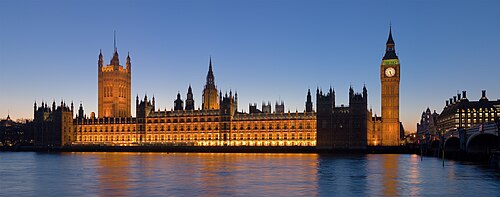
The Houses of Parliament
Rebuilt from the ashes of the 1834 fire, the Palace of Westminster made Gothic Revival the face of British democracy — and gave London its most famous silhouette.

The Albert Memorial
A 176-foot Gothic shrine in Kensington Gardens — Queen Victoria's monument to the husband she lost, crowded with 169 sculpted geniuses and four continents.