Kelvingrove Art Gallery and Museum
Simpson & Allen's palace of fine arts, 1901

📌 Pin it
Kelvingrove exists because an exhibition made money. Glasgow's International Exhibition of 1888, held in Kelvingrove Park, turned such a surplus that the city decided to spend it on a permanent home for its art and museum collections. A competition held in 1891 — judged by Alfred Waterhouse, architect of London's Natural History Museum — was won in 1892 by the London firm of John W. Simpson and E. J. Milner Allen, a choice that drew predictable protests from Glasgow's own architects. They built in red Locharbriggs sandstone in a grand Spanish Baroque style, and the building opened on 2 May 1901 as the Palace of Fine Arts for that year's Glasgow International Exhibition, which drew 11.5 million visitors. It passed to the city as its civic art gallery and museum the following year, fully opening to the public on 1 October 1902.
The building is wrapped in one of Glasgow's favourite myths: that it was built back to front, and the architect threw himself from a tower in despair. Neither is true — the ceremonial front faces the River Kelvin, as designed, while the busy everyday entrance faces Argyle Street. What is true is that the building was designed around music as much as art: its Centre Hall was built as a concert space, and the great pipe organ by Lewis & Co., installed for the 1901 exhibition, is still played in a free recital every day. And its most famous possession arrived half a century later: Salvador Dalí's Christ of St John of the Cross, bought in 1952 for £8,200 by the museums director Tom Honeyman — a purchase so controversial at the time that art students petitioned against it, and so far-sighted that the copyright Honeyman also secured has earned the city back many times what it paid.
Kelvingrove opened in 1901, the year Queen Victoria died — the last great civic palace of her reign, and the first of a new century's public museums. It holds 22 galleries and more than 8,000 objects, from French Impressionists to medieval armour, a Spitfire hanging in the West Court and the work of Glasgow's own Charles Rennie Mackintosh. After a three-year, £27.9 million refurbishment it reopened in July 2006, and it remains Scotland's most popular free attraction, drawing more than a million visitors a year to a building that was, from the first, a palace for the people.
Frequently asked
Was Kelvingrove really built back to front?
No — it is Glasgow's favourite architectural myth. The ceremonial front was always meant to face the River Kelvin, while the entrance most visitors use faces Argyle Street. No architect jumped from a tower; the story is entirely invented.
Why is the Dalí painting so famous?
Christ of St John of the Cross, painted in 1951, was bought for Glasgow in 1952 for £8,200 by museums director Tom Honeyman — a price attacked at the time as extravagant, with art students petitioning against it. It is now regarded as Scotland's favourite painting, and the copyright Honeyman secured with it has earned the city many times the purchase price.
Is Kelvingrove free to visit?
Yes — like the other national museums, admission is free. It is Scotland's most popular free visitor attraction, with 22 galleries, a free daily organ recital in the Centre Hall, and more than a million visitors a year.
Why it matters today
Kelvingrove made the civic museum a palace for the people — free, encyclopaedic and open to everyone — and its funding model, one great exhibition paying for a permanent palace, is still the way cities dream of building museums.
More in Architecture & Design
All →
The Crystal Palace
A gardener's glasshouse scaled up to hold the world — 1,848 feet of iron and glass, six million visitors in a single summer, then a single night of fire.
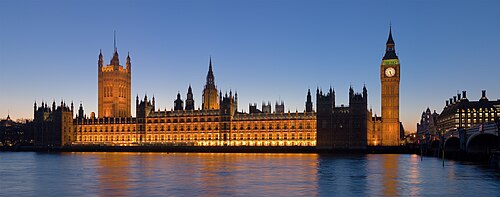
The Houses of Parliament
Rebuilt from the ashes of the 1834 fire, the Palace of Westminster made Gothic Revival the face of British democracy — and gave London its most famous silhouette.

The Albert Memorial
A 176-foot Gothic shrine in Kensington Gardens — Queen Victoria's monument to the husband she lost, crowded with 169 sculpted geniuses and four continents.