Cardiff Castle
Burges's Gothic fantasy palace, 1865–1881

📌 Pin it
Cardiff Castle is three castles in one enclosure: the stone walls of a Roman fort first raised in the first century AD, a Norman keep on its high earthen motte from the late eleventh century, and — rising out of both — a Victorian Gothic palace so richly coloured and gilded that it still startles visitors who have seen a hundred castles. By the eighteenth century the place was a comparative ruin, its ten acres passed by marriage to the Bute family, who made their fortune from the South Wales coal shipped through Cardiff's docks. In 1865 the young John Patrick Crichton-Stuart, 3rd Marquess of Bute — reputedly the richest man in Britain — met the architect William Burges, and the two discovered a shared obsession with the medieval world. Burges began planning the transformation that year; work began in earnest when Bute came of age in 1868.
Burges was given his head and an effectively unlimited budget, and he used both to build upwards in a series of extraordinary towers of differing shapes and sizes — the Clock Tower of 1869–1874, more than 130 feet high, its faces carrying nine-foot figures of the planets Mercury, Luna, Mars, Jupiter, Saturn, Venus and Sol — and inwards, tunnelling through thick medieval walls to create passageways and opening small rooms into great ones. Inside, almost no surface is left plain: the Banqueting Hall is lined with murals of the castle's medieval story, the Arab Room glitters under a gilded honeycomb dome inspired by Islamic architecture, the Library's chimneypiece is carved with monkeys mocking Darwin, and the Nursery is painted with fairy-tale scenes. Burges died in 1881 with the project unfinished; his assistants completed it from his drawings.
Outside, the fantasy continues along Castle Street in the Animal Wall — carved stone animals conceived by Burges and built in the mid-1880s to 1890s by his assistant William Frame, nine of them carved by Thomas Nicholls and six more added later by Alexander Carrick — free to admire from the pavement. The castle's later history is just as layered: during the Second World War the hollow galleries inside its walls were fitted out as air-raid shelters for up to about 1,800 Cardiff residents, and in 1947 the 5th Marquess gave the castle and its park to the city. It is now Wales's most visited historic attraction, and the purest surviving example of High Victorian Gothic as a total work of art — architecture, painting, carving and furniture conceived as a single dream.
Frequently asked
Is Cardiff Castle a real medieval castle?
Partly. The Roman walls and the Norman keep on its motte are genuinely medieval, but the palace you tour is William Burges's Victorian fantasy of the Middle Ages, built 1865–1881 for the 3rd Marquess of Bute — a nineteenth-century dream of the medieval world, not a survival of it.
Who was the 3rd Marquess of Bute?
John Patrick Crichton-Stuart (1847–1900), who inherited a fortune built on South Wales coal shipped through Cardiff's docks and was reputedly the richest man in Britain. A Catholic convert and passionate medievalist, he gave Burges an effectively unlimited budget and sixteen years to realise the castle.
Can you see the Animal Wall without paying?
Yes — the carved stone animals run along Castle Street on the castle's south front and are free to see from the pavement, including the lion, the bear, the pelican and the anteater.
Why it matters today
Cardiff Castle made the Gothic Revival a total work of art — architecture, painting, carving and furniture conceived as one fantasy — and every immersive historic interior since, from film sets to heritage attractions, descends from Burges's rooms.
More in Architecture & Design
All →
The Crystal Palace
A gardener's glasshouse scaled up to hold the world — 1,848 feet of iron and glass, six million visitors in a single summer, then a single night of fire.
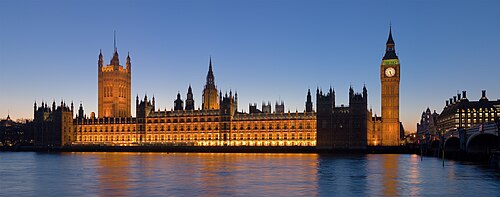
The Houses of Parliament
Rebuilt from the ashes of the 1834 fire, the Palace of Westminster made Gothic Revival the face of British democracy — and gave London its most famous silhouette.

The Albert Memorial
A 176-foot Gothic shrine in Kensington Gardens — Queen Victoria's monument to the husband she lost, crowded with 169 sculpted geniuses and four continents.