Manchester Town Hall
Waterhouse's Gothic palace of cotton, 1877

📌 Pin it
By the 1860s Manchester — the cotton capital of the world — had outgrown its King Street town hall of 1822, and the city wanted a building to match its wealth. A competition drew 137 entries, and Alfred Waterhouse, the architect who would later design London's Natural History Museum, was appointed on 1 April 1868. The foundation stone was laid on 26 October that year, and construction took nine years and 14 million bricks, at a cost estimated between £775,000 and £1 million.
The building opened on 13 September 1877, unveiled by the mayor Abel Heywood — the project's great champion — after Queen Victoria declined to attend. Its clock tower rises 280 feet over Albert Square, its four dials inscribed 'Teach us to number our Days', from Psalm 90, and its clock, made by Gillett and Bland, has kept time since New Year's Day 1879. Behind the dials hangs Great Abel, the eight-ton clock bell named for Heywood and inscribed with Tennyson's line 'Ring out the false, ring in the true', above a carillon of 23 bells.
Inside, the Great Hall is lined with Ford Madox Brown's Manchester Murals, twelve paintings telling the history of the city from the Romans to the Victorian age, and an organ by Aristide Cavaillé-Coll with more than 5,000 pipes. The Sculpture Hall holds busts of Manchester's great men — the chemist John Dalton, the physicist James Prescott Joule, the conductor John Barbirolli. Grade I listed in 1952, the town hall is regarded as one of the finest interpretations of Gothic Revival architecture in the world; it has been closed since 2018 for a major restoration and is due to reopen in spring 2027.
Frequently asked
Why does a town hall need to be so grand?
Because Victorian Manchester was the richest industrial city on earth, and its council wanted a building that said so. The town hall was a statement of civic pride — proof that a city built on cotton could build in stone as finely as any capital.
Can you visit Manchester Town Hall now?
Not yet — the building and Albert Square have been closed since 2018 for a major restoration, and are due to reopen in spring 2027. The square and the Albert Memorial outside remain worth a look meanwhile.
What are the Manchester Murals?
Twelve paintings by Ford Madox Brown lining the Great Hall, telling Manchester's story from the Romans building a fort at Mancenion to the Victorian cotton age. They are not true frescoes but use the Gambier Parry process, a Victorian technique for painting on a hard, washable surface.
Why it matters today
It set the standard for the Victorian town hall — the Gothic civic palace every industrial city wanted — and its restoration, one of the largest heritage projects in Britain, is now the model for saving such buildings rather than replacing them.
More in Architecture & Design
All →
The Crystal Palace
A gardener's glasshouse scaled up to hold the world — 1,848 feet of iron and glass, six million visitors in a single summer, then a single night of fire.
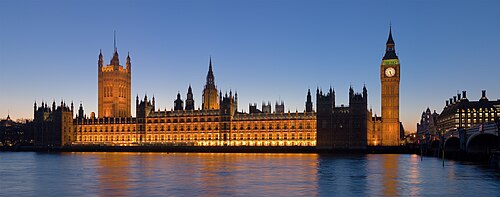
The Houses of Parliament
Rebuilt from the ashes of the 1834 fire, the Palace of Westminster made Gothic Revival the face of British democracy — and gave London its most famous silhouette.

The Albert Memorial
A 176-foot Gothic shrine in Kensington Gardens — Queen Victoria's monument to the husband she lost, crowded with 169 sculpted geniuses and four continents.