Highgate Cemetery
Geary's garden of the dead, 1839

📌 Pin it
By the 1830s London's churchyards were overflowing — literally, in the cholera years — and Parliament allowed private companies to build garden cemeteries beyond the city. Seven were founded, the Magnificent Seven, and Highgate was the third. The London Cemetery Company was founded in 1836 by the architect and entrepreneur Stephen Geary, who bought 17.5 acres on a steep hillside at Highgate, part of the grounds of Ashurst Manor. The cemetery was consecrated by the Bishop of London on 20 May 1839, and the first burial, Elizabeth Jackson of Soho, followed on 26 May.
Geary laid the ground out as a landscape, not a graveyard: winding paths, terraces and grand monuments climbing the hill. Its showpiece is the Egyptian Avenue, a stone passage lined with burial vaults in Egyptian style — obelisks, lotus-bud columns, winged serpents — built when Egyptomania, fired by Napoleon's campaigns and the deciphering of hieroglyphs, made ancient Egypt the height of funerary fashion. The avenue, about a hundred feet long, opens onto the Circle of Lebanon, a ring of family vaults built around a huge cedar of Lebanon that already stood on the site. Tudor-Gothic chapels, one Anglican and one for Dissenters, flank the entrance.
Some 170,000 people lie in around 53,000 graves across the two sides — the East Cemetery was added across Swain's Lane in the 1850s. Karl Marx, buried in 1883 beneath a plain slab with only thirteen mourners, was reburied in 1956 beneath the great bearded bust that now draws visitors from around the world; nearby lie George Eliot, Christina Rossetti, Michael Faraday and Douglas Adams, whose fans leave pens on his grave. The cedar at the heart of the Circle of Lebanon was felled in 2019, nearly 200 years old, after surviving a lightning strike. The Friends of Highgate Cemetery, formed in 1975, rescued the neglected ground, and the whole site is Grade I listed — still a working cemetery, open daily.
Frequently asked
Why is a London cemetery full of Egyptian imagery?
Egyptomania: Napoleon's campaign in Egypt and the deciphering of hieroglyphs in 1822 made ancient Egypt the height of fashion, and for a cemetery it was perfect — the Egyptians were the great civilisation of death, pyramids and all.
Can you visit both sides of Highgate Cemetery?
Yes — one ticket covers both. The East Cemetery, where Marx lies, can be wandered freely, while the West Cemetery, with the Egyptian Avenue and the Circle of Lebanon, is best seen on a guided tour.
Who else is buried at Highgate?
George Eliot, Christina Rossetti, the scientist Michael Faraday, the Pre-Raphaelite model Elizabeth Siddal, and Douglas Adams, whose fans leave pens on his gravestone.
Why it matters today
Highgate helped turn the cemetery into a public landscape — part park, part open-air museum, part pilgrimage — and the garden-cemetery idea it embodied is now the standard for burial grounds across Britain.
More in Architecture & Design
All →
The Crystal Palace
A gardener's glasshouse scaled up to hold the world — 1,848 feet of iron and glass, six million visitors in a single summer, then a single night of fire.
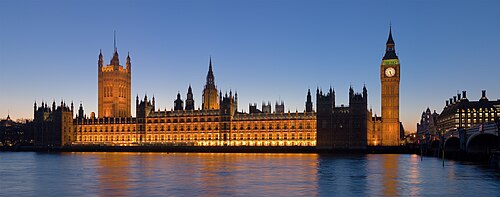
The Houses of Parliament
Rebuilt from the ashes of the 1834 fire, the Palace of Westminster made Gothic Revival the face of British democracy — and gave London its most famous silhouette.

The Albert Memorial
A 176-foot Gothic shrine in Kensington Gardens — Queen Victoria's monument to the husband she lost, crowded with 169 sculpted geniuses and four continents.