Waddesdon Manor
A Loire château on a Buckinghamshire hill, 1874–89

📌 Pin it
In the autumn of 1874 Baron Ferdinand de Rothschild — banker, Liberal MP, and one of Europe's great collectors — bought a bare agricultural estate in Buckinghamshire from the Duke of Marlborough, and set out to build a house for his treasures. The site he chose was Lodge Hill, a steep, treeless eminence 614 feet above sea level with views over several counties. The summit was levelled over three years, the foundation stone was laid on 18 August 1877, and the house rose to designs by the French architect Gabriel-Hippolyte Destailleur, in the style of a sixteenth-century Loire château — above all Chambord, with towers borrowed from Blois, Maintenon and Chaumont.
Waddesdon was never meant to be a family home in the ordinary sense. Ferdinand, a widower, built it as a weekend house for entertaining — his Saturday-to-Monday parties gathered the Victorian social and political elite, royalty included — and as a setting for his collection of French eighteenth-century art, Sèvres porcelain, English portraits and Dutch Old Masters. Rooms were panelled with boiseries salvaged from demolished Parisian houses, and the house was fitted with comforts — electricity, hot water, lifts — that quietly outran the French originals it copied. Ferdinand first slept in the bachelors' wing in 1880 and in the main house in 1883; the work was not finished until 1889.
Ferdinand died in 1898 and the house passed to his sister Alice, who preserved it as his memorial; then to his great-nephew James de Rothschild, who bequeathed house, contents and grounds to the National Trust in 1957. It opened to the public in 1959, and it remains the most complete surviving example of what contemporaries called the goût Rothschild — the Rothschild taste — its collections still intact and still growing.
Frequently asked
Why build a French château in Buckinghamshire?
Because Ferdinand had fallen in love with the châteaux of the Loire on a tour of Touraine, and he trusted a French architect who knew the sixteenth-century style better than any English one. Destailleur composed the house from features borrowed from Chambord, Blois, Maintenon and Chaumont.
What is the goût Rothschild?
The "Rothschild taste": the family's way of collecting and furnishing — French eighteenth-century furniture and porcelain, Old Master paintings, rooms panelled with historic boiseries — displayed in houses built as settings for the collection. Waddesdon is its most complete surviving example.
Can you visit Waddesdon Manor?
Yes — Waddesdon Manor is open to the public under the National Trust, with the house, gardens and park to explore.
Why it matters today
Waddesdon fixed the country house as a museum in all but name — a building designed around a collection rather than a family — and it remains the benchmark for how a great house and its treasures survive together.
More in Architecture & Design
All →
The Crystal Palace
A gardener's glasshouse scaled up to hold the world — 1,848 feet of iron and glass, six million visitors in a single summer, then a single night of fire.
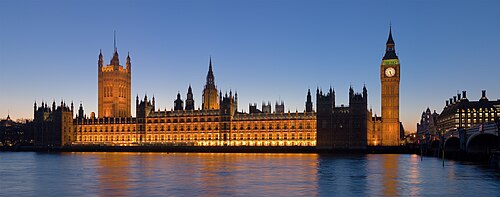
The Houses of Parliament
Rebuilt from the ashes of the 1834 fire, the Palace of Westminster made Gothic Revival the face of British democracy — and gave London its most famous silhouette.

The Albert Memorial
A 176-foot Gothic shrine in Kensington Gardens — Queen Victoria's monument to the husband she lost, crowded with 169 sculpted geniuses and four continents.