The Scott Monument
A Gothic spire for Scotland's novelist, 1846

📌 Pin it
Sir Walter Scott died in 1832, and within four years Edinburgh was holding a competition for his memorial. The winner, announced in 1838, was a design submitted under the pseudonym "John Morvo" — the name of the medieval master mason of Melrose Abbey. Morvo was in fact George Meikle Kemp, a 45-year-old joiner, draughtsman and self-taught architect who had never built anything of consequence. His design was a soaring Gothic spire in the manner of Melrose Abbey, to stand in Princes Street Gardens. The foundation stone was laid on 15 August 1840, and the monument was built of Binny sandstone, pale when it went up.
Kemp never saw it finished. On the foggy evening of 6 March 1844 he fell into the Union Canal while walking home from the site and drowned. Work continued under his brother-in-law William Bonnar, and in the autumn of 1844 Kemp's ten-year-old son Thomas placed the topmost stone. The monument was inaugurated on 15 August 1846 — six years to the day after the foundation stone — before vast crowds, with Sir John Steell's colossal Carrara marble statue of Scott seated beneath the canopy, his faithful dog Maida at his feet.
At 200 feet 6 inches, reached by 287 spiral steps, the Scott Monument is the largest monument to a writer anywhere in the world. Its niches hold 64 statuettes of characters from Scott's novels — Ivanhoe, the Heart of Mid-Lothian, Waverley — and the pale Binny stone has long since blackened with a century and a half of Edinburgh smoke, giving the spire the brooding look it is famous for. It stands opposite the former Jenners building on Princes Street, a short walk from Waverley Station, itself named after Scott's novels.
Frequently asked
Why is the Scott Monument black?
It wasn't — the Binny sandstone was pale when the monument went up in the 1840s. A century and a half of coal smoke and soot blackened it, and the dark colour is now part of its character, though the statue of Scott himself was cleaned and glows white.
Who was John Morvo?
He was the medieval master mason of Melrose Abbey, whose Gothic arches Kemp's design echoed. Kemp, a joiner with no architectural training, used the pseudonym so the judges would weigh the design, not the designer.
Can you climb the Scott Monument?
Yes — visitors can climb the 287 spiral steps to the viewing platforms for panoramic views over central Edinburgh, and see the 64 statuettes of Scott's characters up close.
Why it matters today
The Scott Monument made the literary memorial a national art form — no other writer on earth has a monument its size — and it fixed Scott, and Scotland's stories, at the centre of Edinburgh's skyline.
More in Architecture & Design
All →
The Crystal Palace
A gardener's glasshouse scaled up to hold the world — 1,848 feet of iron and glass, six million visitors in a single summer, then a single night of fire.
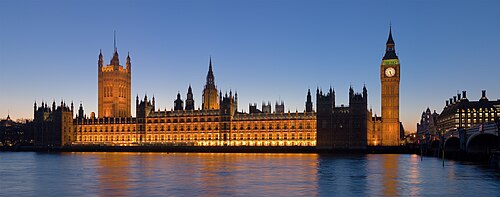
The Houses of Parliament
Rebuilt from the ashes of the 1834 fire, the Palace of Westminster made Gothic Revival the face of British democracy — and gave London its most famous silhouette.

The Albert Memorial
A 176-foot Gothic shrine in Kensington Gardens — Queen Victoria's monument to the husband she lost, crowded with 169 sculpted geniuses and four continents.