Glasgow City Chambers
The Second City's marble palace, 1888

📌 Pin it
By the 1880s Glasgow was the Second City of the Empire — shipbuilding, engineering and trade had made it one of the richest cities in the world — and its town council was still working out of cramped old rooms. The city decided its government needed a palace. A first competition failed to settle the matter; a second, launched in 1881, drew some 125 entries. The winner was William Young, a Paisley-born architect practising in London, whose Italian Renaissance design promised to show the world Glasgow's wealth. The foundation stone was laid on 6 October 1883 before huge crowds, and the building rose on the east side of George Square.
Queen Victoria herself opened the City Chambers on 22 August 1888, and more than 400,000 people came to look round in the first ten days. The cost was about £500,000 — far over the £150,000 originally set aside — and every pound shows. The entrance hall floor carries the city's coat of arms in mosaic; beyond it rises the famous staircase of white Carrara marble, climbing three storeys and reputedly the largest marble staircase in Western Europe. Around it are mosaic ceilings, gold leaf, Spanish mahogany panelling, stained glass and more than a million and a half hand-laid tiles.
The first council meeting was held in October 1889, and the building has been the seat of Glasgow's government ever since. It is still a working building rather than a museum, but free weekday tours let the public climb the marble staircase — which is so grand that film-makers have used it to stand in for the Vatican.
Frequently asked
Why is a town hall so grand?
Because Glasgow in the 1880s was the Second City of the Empire, rich on shipbuilding and trade, and the council wanted a building that announced it. The Italian Renaissance palace, its marble staircase and gold-leaf ceilings were a deliberate statement of civic wealth and confidence.
Can you visit Glasgow City Chambers?
Yes — free guided tours run on weekdays, taking in the marble staircase, the banqueting hall and the council chamber. It is a working council building, so tours run around the council's business.
What is special about the marble staircase?
It is made of white Carrara marble imported from Italy, rises through three storeys, and is reputedly the largest marble staircase in Western Europe — bigger, the guides like to say, than the Vatican's.
Why it matters today
The City Chambers fixed the image of the grand Victorian town hall — every industrial city that followed built its own palace of marble and mosaic — and it remains the working heart of Glasgow's civic life.
More in Architecture & Design
All →
The Crystal Palace
A gardener's glasshouse scaled up to hold the world — 1,848 feet of iron and glass, six million visitors in a single summer, then a single night of fire.
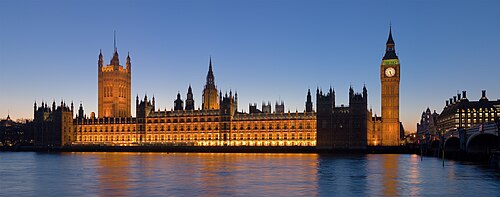
The Houses of Parliament
Rebuilt from the ashes of the 1834 fire, the Palace of Westminster made Gothic Revival the face of British democracy — and gave London its most famous silhouette.

The Albert Memorial
A 176-foot Gothic shrine in Kensington Gardens — Queen Victoria's monument to the husband she lost, crowded with 169 sculpted geniuses and four continents.