The Royal Courts of Justice
Street's Gothic law courts, 1882

📌 Pin it
Before 1882, England's civil courts were scattered — cases heard in Westminster Hall and borrowed rooms across London. A competition held in 1866–67 drew twelve architects, and the winner, announced in 1868, was George Edmund Street, the Gothic Revival's most scholarly practitioner. Seven acres of old housing north of the Strand were cleared for the site, the foundation stone was laid in 1874, and Street drew almost every detail himself — so completely that the building is often called his life's work. He did not live to see it: worn out by the effort, he died in December 1881, a year before it opened, and the work was completed by his son Arthur Street and Sir Arthur Blomfield.
Queen Victoria opened the courts on 4 December 1882. The building is 470 feet from east to west, with a spire rising 245 feet from Strand level, and it contains more than a thousand rooms reached by miles of corridors. Its heart is the Great Hall, 238 feet long, 48 feet wide and 80 feet high, floored in Italian marble mosaic and lit by heraldic windows — the courts themselves open off it, like chapels off a cathedral nave. The whole vast pile was paid for, remarkably, with £700,000 of cash accumulated in court from the estates of people who had died intestate.
The courts still do their original job: the building houses the High Court and the Court of Appeal of England and Wales, and its Strand frontage — barristers in gowns, television cameras, campaigners on the steps — is one of the most familiar sights in British public life. It is Grade I listed and regarded as the foremost work of its architect and one of the finest examples of High Victorian Gothic anywhere. Street's memorial stands in the Great Hall itself, a seated figure by H. H. Armstead ringed by workmen building the courts — the architect watching over the building that killed him.
Frequently asked
Why build a law court in Gothic style?
The Victorians believed Gothic was Britain's true national style — moral, honest and rooted in the medieval past — and therefore the right language for the law. Street's courts are the grandest statement of that belief, and have been called the last great secular building of the Gothic Revival.
Did George Edmund Street see his courts finished?
No — he died in December 1881, exhausted by the work, a year before Queen Victoria opened the building. His son Arthur Street and Sir Arthur Blomfield completed it, and a memorial to Street stands in the Great Hall.
What happens inside the Royal Courts of Justice today?
It houses the High Court and the Court of Appeal of England and Wales — the senior civil courts. Members of the public can watch most hearings from the public galleries.
Why it matters today
The Law Courts made Gothic Revival the architecture of justice — courthouses across Britain and the empire copied its towers, tracery and great hall for a century, and its Strand silhouette remains the visual shorthand for the English legal system.
More in Architecture & Design
All →
The Crystal Palace
A gardener's glasshouse scaled up to hold the world — 1,848 feet of iron and glass, six million visitors in a single summer, then a single night of fire.
The Houses of Parliament
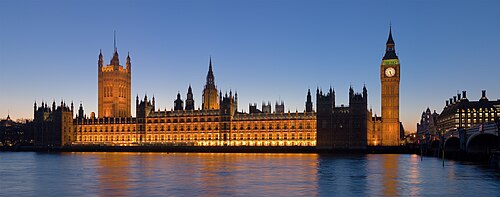
Rebuilt from the ashes of the 1834 fire, the Palace of Westminster made Gothic Revival the face of British democracy — and gave London its most famous silhouette.

The Albert Memorial
A 176-foot Gothic shrine in Kensington Gardens — Queen Victoria's monument to the husband she lost, crowded with 169 sculpted geniuses and four continents.