Leadenhall Market
Horace Jones's iron-and-glass arcade, 1881

📌 Pin it
Few patches of London ground have been traded on for longer. Beneath Leadenhall lie the remains of Roman Londinium's forum and basilica, the largest basilica north of the Alps when it was rebuilt around AD 100. By 1321 poulterers were meeting at a lead-roofed manor house on the spot — the Leaden Hall that gave the market its name — and in 1408 the site was acquired by Richard 'Dick' Whittington, who gifted it to the City of London in 1411. It survived the Great Fire of 1666 and three centuries as a meat and poultry market before the Victorian City decided a slaughterhouse no longer suited its financial district.
The City Architect, Sir Horace Jones — the man behind Smithfield and Billingsgate markets, and the designer of Tower Bridge — was commissioned to make the market respectable. His building of 1881, which cost £99,000 with a further £148,000 spent on the approaches, is a cross of four covered avenues meeting at an octagonal crossing under a dome, roofed in barrel-vaulted glass on painted wrought-iron ribs. Jones took his model from the Galleria Vittorio Emanuele II in Milan, but the crooked ground plan follows medieval rights of way, and the details are pure City of London: cast-iron dragons worked into the columns, Dutch-gabled frontages on Gracechurch Street, and the date A.D. 1881 set in gold over the arches.
The market was Grade II* listed in 1972 and beautifully restored in 1990–91, its cream, maroon and green paintwork brought back to Jones's scheme. It still trades — boutique shops, restaurants, wine bars and an old pub beneath the glass roof — and it still draws crowds for a second reason: the doorway in Bull's Head Passage stood in for the entrance to the Leaky Cauldron in Harry Potter and the Philosopher's Stone. Seven centuries after the poulterers, the arcade is the City's best-preserved piece of Victorian street architecture.
Frequently asked
Where does the name Leadenhall come from?
From a lead-roofed manor house that stood on the site in the 14th century — the 'Leaden Hall'. The market that grew up around it took the name, and it has stuck for 700 years.
Who designed the current market?
Sir Horace Jones, the City of London's architect, who also designed Smithfield and Billingsgate markets and drew the original design for Tower Bridge. His 1881 Leadenhall is a wrought-iron and glass arcade inspired by Milan's Galleria Vittorio Emanuele II.
Can you still shop at Leadenhall Market?
Yes — it is a working market of boutique retailers, restaurants, cafes, wine bars and a historic pub, open to the public in the heart of the City. It is at its liveliest on weekdays and quietest on Sundays.
Why it matters today
Leadenhall made the covered market a civic ornament — its iron-and-glass arcade became the template for Victorian market halls and shopping arcades across Britain, the direct ancestor of the glass-roofed shopping arcade and, in the end, the mall.
More in Architecture & Design
All →
The Crystal Palace
A gardener's glasshouse scaled up to hold the world — 1,848 feet of iron and glass, six million visitors in a single summer, then a single night of fire.
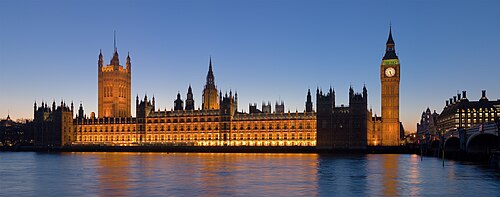
The Houses of Parliament
Rebuilt from the ashes of the 1834 fire, the Palace of Westminster made Gothic Revival the face of British democracy — and gave London its most famous silhouette.

The Albert Memorial
A 176-foot Gothic shrine in Kensington Gardens — Queen Victoria's monument to the husband she lost, crowded with 169 sculpted geniuses and four continents.