The Great Gold Robbery of 1855
£12,000 of gold swapped for lead shot on the 8:30 to Folkestone — the perfect crime, undone by a lover's quarrel
📌 Pin it
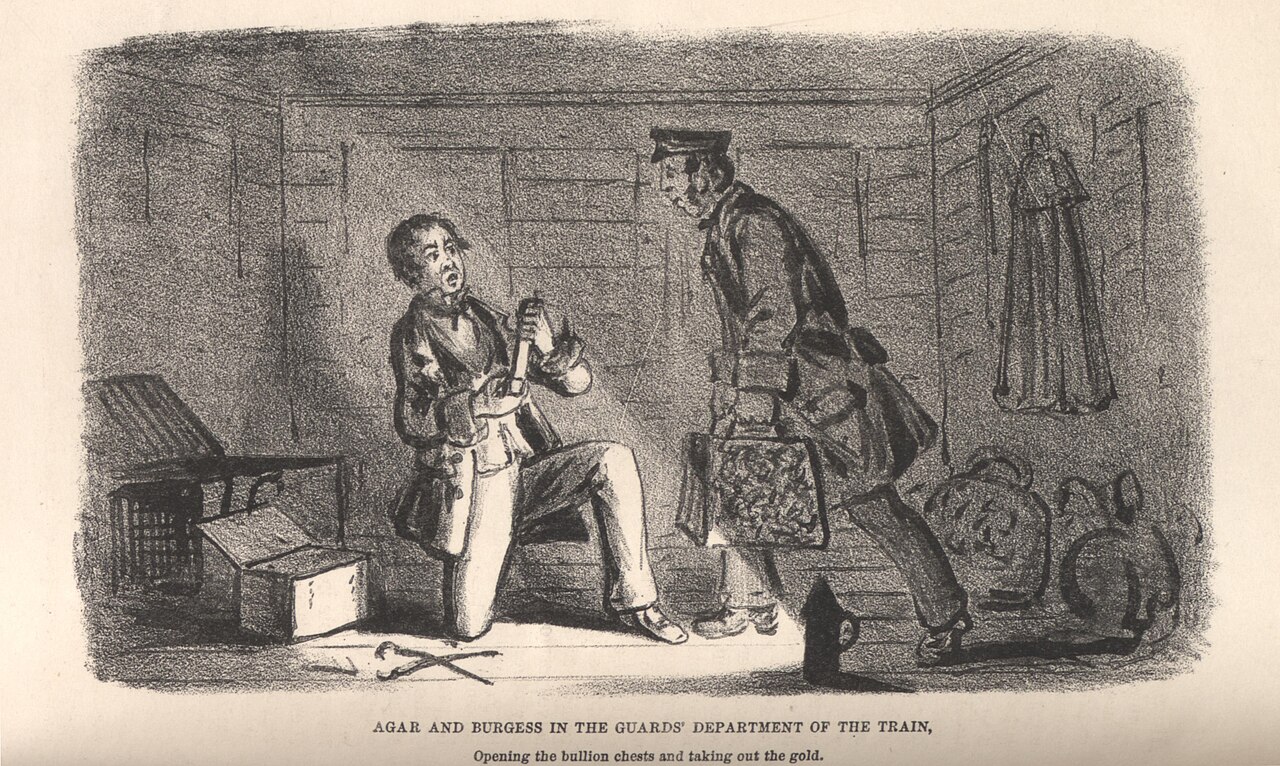
On the night of 15 May 1855, the South Eastern Railway's 8:30 pm mail train left London Bridge for Folkestone carrying three wooden boxes of gold — bullion and coins from the dealers Abell & Co, Adam Spielmann & Co and Messrs Bult & Co, bound for Paris and worth £12,000. The boxes were sealed with wax, locked inside iron travelling safes made by Chubb & Son, and weighed at every stage of the journey. The safes needed two keys, and no one person held both: one key travelled with railway staff, the other with the captain of the cross-Channel steamer. It was, by the standards of the day, a perfect system.
It had already been defeated. The planners were Edward Agar, a career criminal, and William Pierce, a former South Eastern Railway employee dismissed for gambling; their insiders were James Burgess, a train guard, and William Tester, a railway clerk. Months earlier they had taken wax impressions of the safe keys and made their own copies. On the night, Tester made sure Burgess was on guard duty and Agar hid in the guard's van. As the train rattled through Kent, Agar and Burgess opened the safes, emptied them of 224 pounds (102 kg) of gold, and refilled the boxes with lead shot to keep the weight right, resealing them so carefully that nothing looked disturbed. They left the train at Dover with the gold in their luggage. At Boulogne one box weighed forty pounds light; in Paris the boxes were opened to find lead shot.
The crime would have stayed unsolved but for a lover's quarrel. Agar was later jailed for life for an unrelated forgery, and asked Pierce to pass money to Fanny Kay, the mother of his child. Pierce kept it. Destitute, Fanny went to the governor of Newgate Prison and told the police everything; Agar, turning Queen's evidence, confirmed it. Pierce, Tester and Burgess were tried and convicted: Pierce received two years' hard labour, Tester and Burgess fourteen years' transportation. Michael Crichton retold the robbery in his novel The Great Train Robbery (1975) and the film The First Great Train Robbery (1978), with Sean Connery as Pierce.
Frequently asked
How did they open the safes without breaking them?
They never broke anything. Months before the robbery they took wax impressions of the safe keys and had copies made, and on the night Agar hid in the guard's van, opened the safes with the copied keys, swapped the gold for lead shot of the same weight, and resealed the boxes so nothing looked disturbed.
How was the crime solved?
Because one of the robbers betrayed the others. Edward Agar, jailed for life for an unrelated forgery, asked William Pierce to pass money to Fanny Kay, the mother of his child. Pierce kept it, and the destitute Fanny went to the police. Agar then confessed and turned Queen's evidence.
Was the film The First Great Train Robbery a true story?
In outline, yes. Michael Crichton's novel The Great Train Robbery (1975) and his film The First Great Train Robbery (1978), with Sean Connery as Pierce, are based on the 1855 robbery — though Crichton invented dialogue, characters and details, as novelists do.
Why it matters today
The robbery forced railways and banks to rethink how valuables travelled — sealed, weighed and double-locked at every stage — and it gave the world the template for the gentleman heist, from Crichton's novel to every train-robbery film since.
More in Crime & Punishment
All →
Jack the Ripper
Five women murdered in ten autumn weeks in 1888, a killer never caught, and a name from a probably-hoax letter — the most famous unsolved case in history.

The Metropolitan Police
Peel's 1829 Act replaced parish constables and watchmen with a thousand uniformed professionals — and invented the modern police force.

Scotland Yard's Detective Branch
Thirteen years after Peel's police, eight plain-clothes men became Britain's first detectives — and, with Dickens's help, the most famous men in London.