How Accurate Is Crimson Peak? The Real 1887 Behind del Toro's Gothic Romance
Guillermo del Toro's haunted house is a fantasy, but its costumes, its ghosts and its bleeding red clay all have real Victorian roots — and one of them is still being mined.
Crimson Peak (2015), written and directed by Guillermo del Toro with Matthew Robbins, opens in Buffalo, New York, in 1887, when the young Edith Cushing is visited by the ghost of her dead mother. Fourteen years later Edith — now Mia Wasikowska, an aspiring writer of ghost stories — marries the English baronet Thomas Sharpe (Tom Hiddleston) and follows him and his sister Lucille (Jessica Chastain) to Allerdale Hall, a crumbling mansion in Cumberland that sits on a red clay mine. Del Toro insists the film is not a horror movie but a Gothic romance — "a cross between a classic gothic romance, like Jane Eyre, and The Fall of the House of Usher" — and he has cited Ann Radcliffe, the Brontës, Poe, E. T. A. Hoffmann and Henry James as its true sources.
The costumes are the film's most accurate — and most deliberate — element. Costume designer Kate Hawley built more than two hundred period garments, and dressed the two women as opposites: Edith in gold, a butterfly; Lucille in dark velvet, a moth. Look closely and Lucille is out of date on purpose: her high neck, tight sleeves and bustle belong to the late 1870s, nearly identical to an afternoon dress of 1876–78 in the Met's collection, while Edith's clothes run ahead of the 1901 setting, closer to the 1890s — her great puffed sleeves were copied from an original 1890s gown and use three and a half metres of fabric per sleeve. Hawley is frank about it: "The silhouette was true to the period but we did make allowances... it wasn't exact by any means." The anachronism is the point. The Sharpes are dressed out of time because they are out of money and out of their era, clinging to fashions from before their fortunes failed.
The ghosts, too, are built on Victorian foundations. Del Toro wanted them "somewhat ethereal" but grounded in reality, so they were played by actors in practical prosthetics — Doug Jones and Javier Botet — with digital augmentation, rather than pure effects. A Victorian audience would have recognised them at once: the 1860s craze for spirit photography, in which William Mumler claimed his camera caught the dead standing beside the living, had taught the whole culture what a ghost should look like — pale, wounded, half-transparent, standing just behind the sitter. And the film follows the Victorian ghost story's own rule: its ghosts are not evil. As del Toro put it, "I don't make my ghosts evil, the ghosts are ultimately sad." They come to warn, not to harm — exactly as the ghosts of M. R. James and Henry James did.

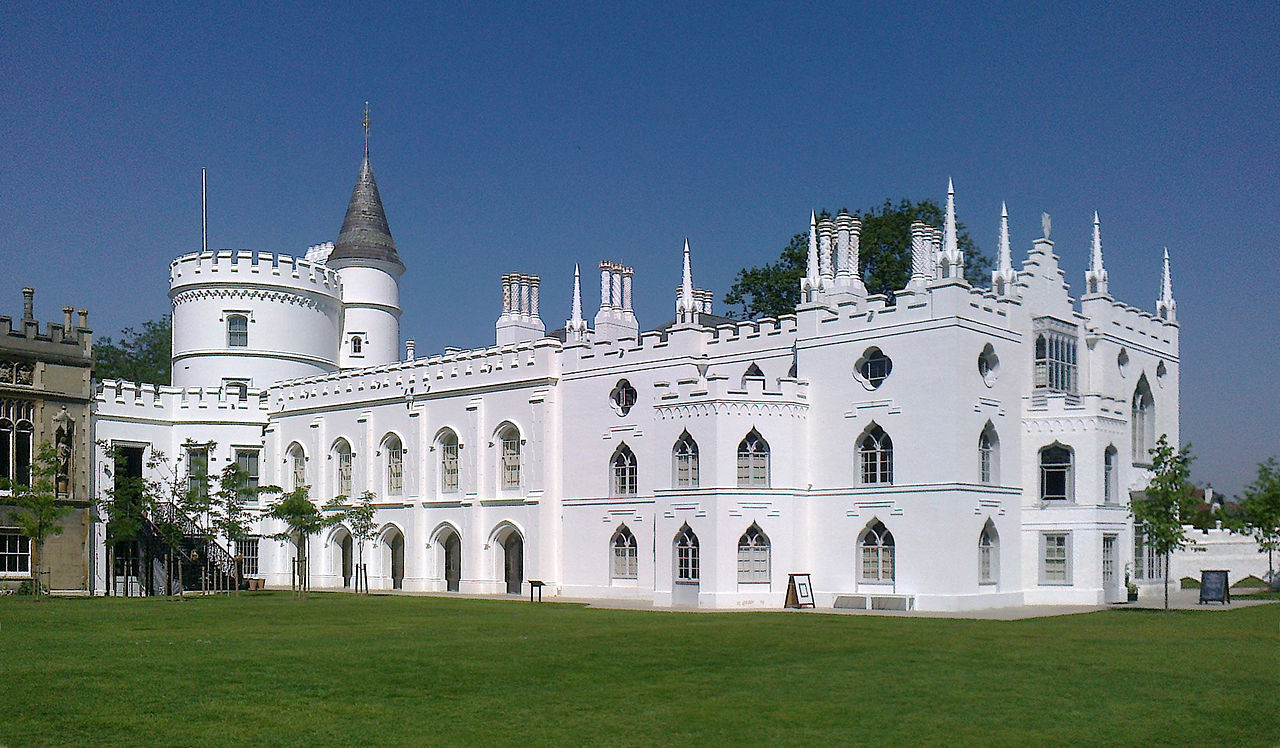
The house itself is the film's great invention — and its great fiction. There is no Allerdale Hall. Del Toro built a full-size, three-storey mansion on a soundstage at Pinewood Toronto Studios, a set that took seven months to construct and that he and Hiddleston both called the largest they had ever worked on; the exterior and the gaping hole in the roof are CGI, and the production department mixed more than forty tons of artificial clay for the interiors. But the model is real: the Gothic Revival that Horace Walpole began at Strawberry Hill in 1749, and the great Victorian country houses that followed it — pointed arches, galleries, gloom and gilt. Even the film's one real house is borrowed: the ballroom scene was shot in the library of Casa Loma in Toronto. The house that sinks into its own mine is a fantasy; the houses it copies are not.
The red clay, though, is the most historically grounded thing in the film. Allerdale Hall sits on a red clay mine in Cumberland, and the real Cumberland — Cleator Moor, Egremont, Frizington — was the centre of the world's haematite trade. The red iron ore lay in beds twenty to thirty feet thick, worked open-cast from the 1860s, and in the early 1870s only Cumbrian haematite was suitable for making steel by the Bessemer process, making the district, in one contemporary account, among the richest mining areas in the world. Cleator Moor grew from 763 people in 1841 to 10,420 by 1871 on the back of the red ore, and the mines left the ground so hollowed out that whole streets subsided. A crumbling house sinking into a played-out red mine, in a county hollowed by its own industry, is exactly what Victorian Cumberland looked like.
So how accurate is Crimson Peak? As history, it is a romance, not a reconstruction — the dates are right, the silhouettes are right, the geology is right, and the deliberate errors are storytelling, not mistakes. What it gets most right is the Victorian Gothic itself: the belief that houses remember, that the dead warn, and that the past bleeds through the floorboards. Score it as the Victorians would have: a ghost story first, a history lesson second — and a very good ghost story at that.
More from the story


Keep exploring
Crimson Peak
The Atlas cabinet entry: the film itself, filed among the essential Victorian screen stories.
How Accurate Is "The Gilded Age"?
The Journal's earlier accuracy check — the real ball, the opera war, and the dress that glowed.
The Wardian Case
Another Victorian obsession with glass, decay and things that refuse to die.