Alfred Russel Wallace
Naturalist and Explorer
📌 Pin it
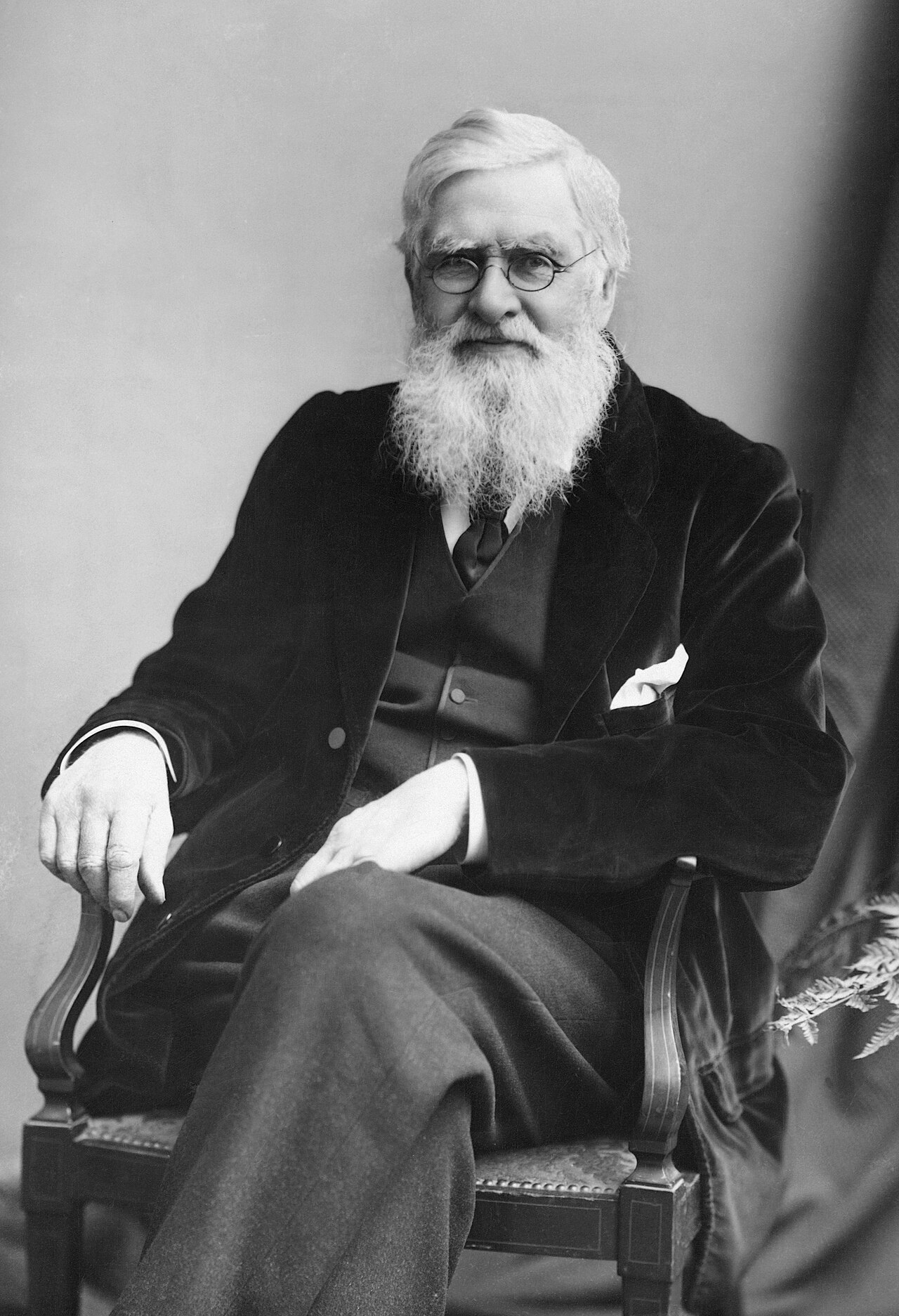
Alfred Russel Wallace was born on 8 January 1823 at Llanbadoc in Monmouthshire, the eighth of nine children of a solicitor whose fortunes were failing. He left school at fourteen, worked as a surveyor, and educated himself in natural history. In 1848 he sailed for the Amazon with the entomologist Henry Walter Bates, spending four years collecting in the rainforest; the voyage home in 1852 ended in disaster when his ship, the Helen, was lost at sea. Undeterred, he set off again in 1854 for the Malay Archipelago, where he would spend eight years travelling among the islands of modern Indonesia and Malaysia, collecting more than 125,000 specimens.
In the archipelago Wallace noticed that the animals on the western islands were Asian in character while those in the east were Australasian — the faunal divide now known as the Wallace Line. His 1855 paper on the geographical distribution of species, written in Sarawak, already argued that new species appear near closely related ones. Then, in February 1858, while ill with malarial fever in the Moluccas, the whole theory fell into place: individuals with traits better suited to their surroundings would survive and leave more offspring. He wrote it out as an essay, 'On the Tendency of Varieties to Depart Indefinitely from the Original Type', and posted it to Charles Darwin on 9 March 1858. It reached Darwin at Down House on 18 June 1858.
Darwin's friends Charles Lyell and Joseph Hooker arranged for Wallace's essay to be read alongside extracts from Darwin's own unpublished work at the Linnean Society of London on 1 July 1858, sharing the priority between the two men. Darwin published On the Origin of Species the following year, and Wallace's own account of his travels, The Malay Archipelago, appeared in 1869 and has never been out of print. Wallace spent the rest of his long life writing on biogeography — the science he effectively founded — and on social reform. He received the Darwin-Wallace Medal on the fiftieth anniversary of the Linnean reading, 1 July 1908, and died at his home, Old Orchard, near Broadstone in Dorset, on 7 November 1913, aged 90.
Frequently asked
Did Wallace or Darwin discover natural selection first?
They discovered it independently. Darwin had worked out the theory privately over twenty years, but Wallace's essay of February 1858 set it out in full — and it was Wallace's letter that forced Darwin to publish. Their papers were read together at the Linnean Society on 1 July 1858, and the priority is shared.
What is the Wallace Line?
An invisible faunal boundary Wallace identified in the Malay Archipelago: the animals of the western islands (Borneo, Java, Sumatra) are largely of Asian origin, while those of the eastern islands (New Guinea and its neighbours) reflect Australasia. It remains a foundational concept in biogeography.
Why is Wallace less famous than Darwin?
Darwin published the 500-page Origin of Species a year after their joint reading and spent the rest of his life defending and extending the theory, while Wallace moved on to other subjects. He never resented it — he called himself a Darwinian and titled one of his books Darwinism (1889).
Why it matters today
Biogeography — the study of where species live and why — begins with Wallace, and the Wallace Line still frames how scientists map the distribution of life across Southeast Asia and Australasia; every modern account of evolution also rests on the joint Darwin-Wallace papers of 1858.
More in Science & Medicine
All →
Charles Darwin
The naturalist whose theory of evolution by natural selection, published in On the Origin of Species in 1859, rewrote biology.

Florence Nightingale
The 'Lady with the Lamp' who transformed nursing into a trained profession and used statistics to prove that clean hospitals save lives.

John Snow
The doctor who traced a deadly cholera outbreak to a single Soho water pump and founded the science of epidemiology.