Joseph Lister
Surgeon
📌 Pin it
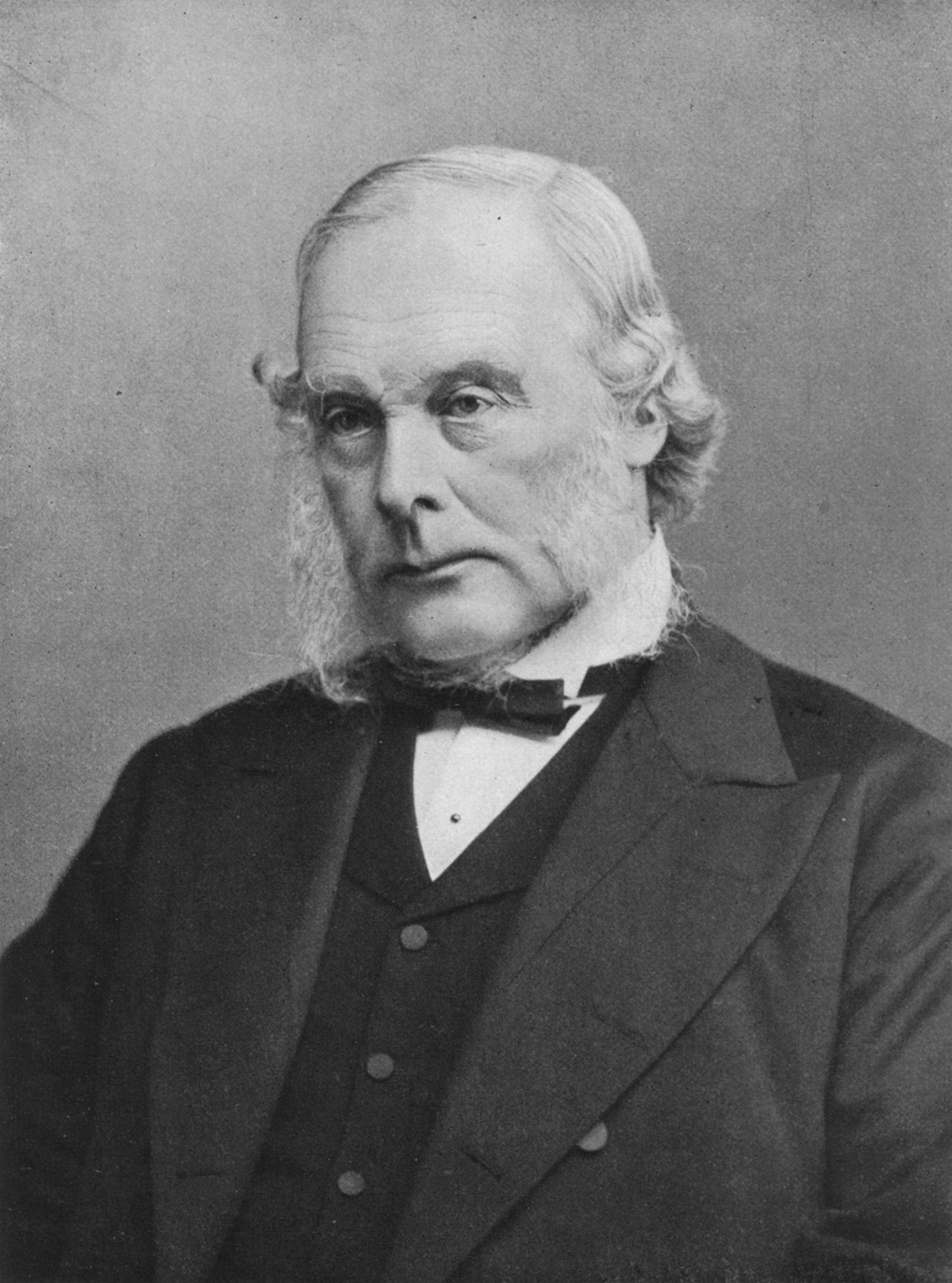
Joseph Lister was born on 5 April 1827 in Upton, Essex, into a prosperous Quaker family — his father had helped perfect the achromatic microscope — and trained in medicine at University College London. As a young surgeon in Edinburgh and then Glasgow, he was haunted by a grim statistic: in the crowded, unventilated wards of the Glasgow Royal Infirmary, nearly half of his surgical patients died, most from wound infections, gangrene, and blood poisoning after operations that had themselves gone well. Compound fractures, where the broken bone pierced the skin, were almost always fatal.
Reading Louis Pasteur's work on fermentation, Lister realised that the same invisible organisms that soured wine might be rotting wounds. In 1865 he began treating compound fractures with carbolic acid — phenol, then used to deodorise sewage in Carlisle — dressing wounds with lint soaked in it, spraying it over instruments, hands, and the air of the operating theatre. His first successful case was on 12 August 1865, an eleven-year-old boy with a compound fracture of the leg who recovered without infection. Between 1864 and 1866, 46 per cent of his surgical patients had died; from 1867 to 1870, after antisepsis, only 15 per cent did.
Lister published his results in a series of papers in The Lancet from March to July 1867, 'On the Antiseptic Principle in the Practice of Surgery', and spent the next decades refining the method and fighting for its acceptance — touring Europe, demonstrating his carbolic spray, and eventually seeing antisepsis adopted worldwide. He became professor of surgery at King's College London in 1877, was made a baron in 1897, and died at his home in Walmer, Kent, on 10 February 1912, aged 84. The mouthwash Listerine, developed in 1879, still carries his name.
Frequently asked
What did Joseph Lister invent?
Lister invented antiseptic surgery: using carbolic acid to kill germs on wounds, instruments, sutures, hands, and the operating-room air. It was the first practical application of germ theory to medicine, and it turned surgery from a desperate gamble into a survivable treatment.
Why did surgeons resist Lister's antiseptic method?
Many surgeons doubted germ theory, disliked the smell and irritation of carbolic acid, and believed wound infection was caused by bad air or the patient's constitution. It took years of published results and demonstrations before antisepsis became standard practice.
Do surgeons still use Lister's methods today?
Not carbolic acid itself — modern surgery uses asepsis (keeping germs out entirely, with sterile instruments, gloves, and gowns) rather than antisepsis. But the underlying principle Lister proved — that microbes cause wound infection and must be excluded — remains the foundation of all surgical practice.
Why it matters today
Sterile gloves, disinfected instruments, and scrubbed hands before surgery all descend from Lister's antiseptic principle — the reason a routine operation today carries a tiny infection risk instead of the near-certain wound sepsis of the 1860s.
More in Science & Medicine
All →
Charles Darwin
The naturalist whose theory of evolution by natural selection, published in On the Origin of Species in 1859, rewrote biology.

Florence Nightingale
The 'Lady with the Lamp' who transformed nursing into a trained profession and used statistics to prove that clean hospitals save lives.

John Snow
The doctor who traced a deadly cholera outbreak to a single Soho water pump and founded the science of epidemiology.