Rain, Steam and Speed
J. M. W. Turner

📌 Pin it
A locomotive of the Great Western Railway thunders across the Thames on Brunel's Maidenhead Railway Bridge, opened in 1839, in the middle of a rainstorm. Rain slashes diagonally across the canvas, the bridge dissolves into mist, and the train itself is barely more than a dark smudge with a lit carriage window. Turner painted speed itself, not a train.
Look closely at the track ahead of the engine and you will find the painting's famous detail: a hare, sprinting along the rails, racing the machine. It is Turner's joke and his argument at once — nature's fastest creature, already losing to the railway. The picture was exhibited at the Royal Academy in 1844, when the railway age was barely a decade old.
Critics of the day were divided between admiration and bewilderment; one complained that the painting looked like a soapsud. But Rain, Steam and Speed became the founding image of modernity in art: the first great painting to treat a machine not as a subject to be documented, but as a force of nature.
Frequently asked
What bridge is in Rain, Steam and Speed?
Brunel's Maidenhead Railway Bridge over the Thames, opened in 1839 — its wide, flat brick arches were an engineering marvel of the day.
Is there really a hare in the painting?
Yes — a small hare sprints along the track ahead of the locomotive, nature's fastest animal racing, and losing to, the new machine.
Where is Rain, Steam and Speed?
The National Gallery, London, where it arrived with the Turner Bequest in 1856.
Why it matters today
Rain, Steam and Speed taught art to paint velocity — every blurred photograph, every speed-line in a comic, every cinematic train shot descends from Turner's storm.
More in Art & Painters
All →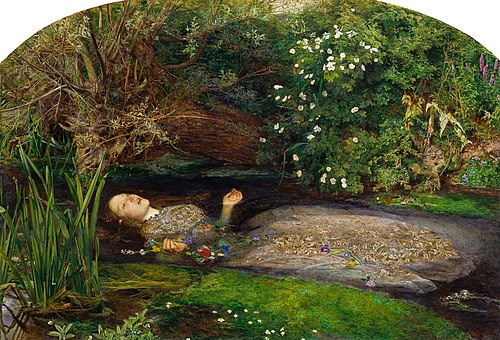
Ophelia
A drowned Shakespearean heroine, painted leaf by leaf on a Surrey riverbank — the image that made the Pre-Raphaelites immortal.

The Lady of Shalott
Tennyson's cursed weaver, caught at the moment she turns to look at Camelot — the most reproduced Victorian painting of them all.

Flaming June
A sleeping woman wrapped in translucent orange silk — the single most famous image of the Aesthetic movement, lost and found again.