Mariana
John Everett Millais
📌 Pin it
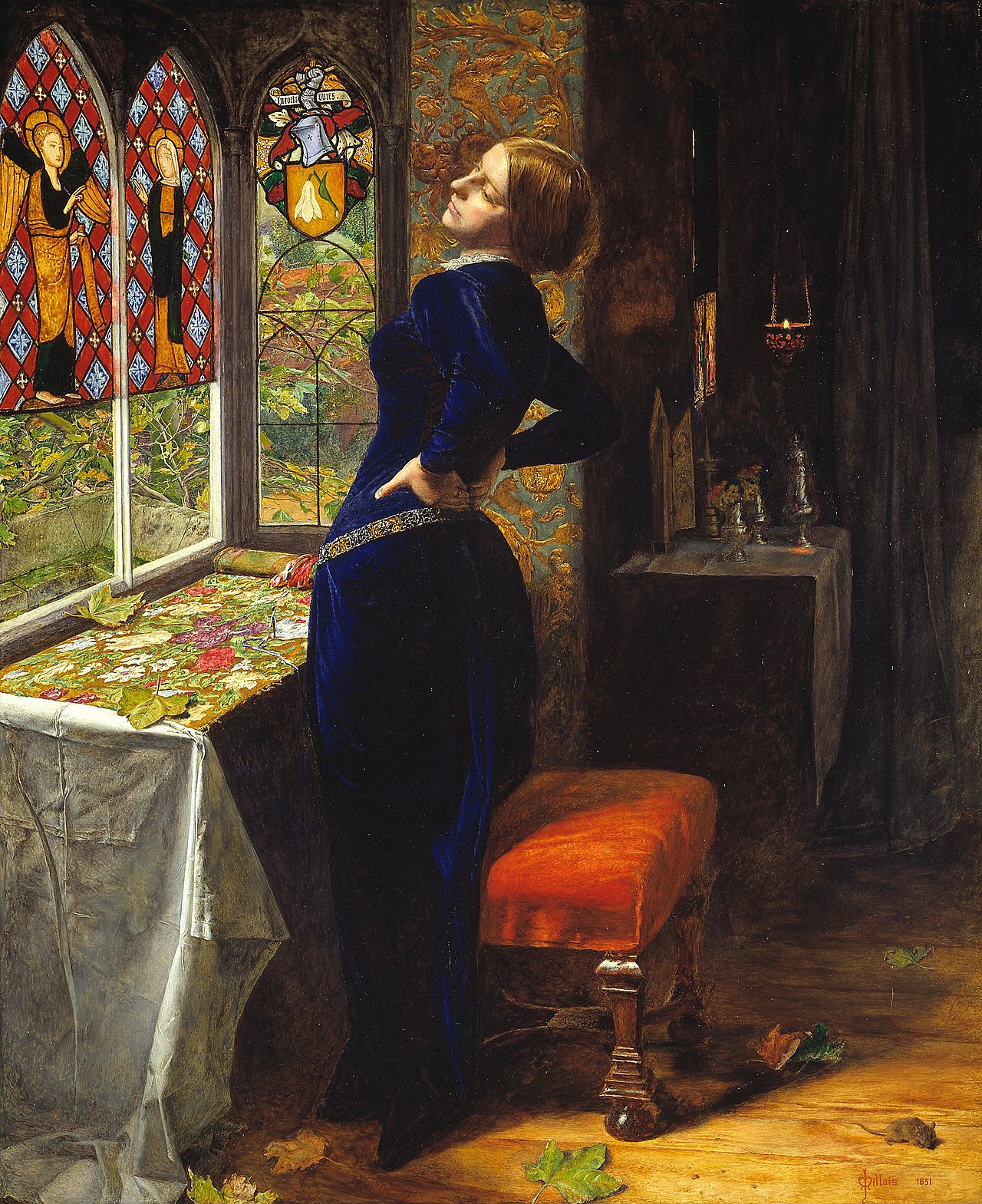
Tennyson's poem 'Mariana' (1830) is a study in waiting: a woman abandoned by her lover in a moated grange, listening to the clock tick and the mouse gnaw, repeating 'I am aweary, aweary, / I would that I were dead!' Millais took the poem and painted it as a room you could step into — the stained-glass window showing the Annunciation, the autumn leaves blown in across the floor, Mariana herself stretched out in her blue dress, her embroidery abandoned in her lap.
The model was Elizabeth Siddal, the red-haired shop-girl turned artists' muse who would later marry Rossetti and pose for Ophelia. Millais painted the picture in 1851, in the first flush of the Pre-Raphaelite Brotherhood, and every detail is a coded quotation from the poem: the mouse on the floor is Tennyson's mouse, the leaves are the poem's autumn, the light falling through the window is the light of a day that will not end. Nothing happens in the picture, and that is the point — it is a portrait of time passing.
Exhibited at the Royal Academy in 1851, Mariana was the first Pre-Raphaelite painting to take a modern poem as its subject and treat it with the seriousness of history painting. It set the pattern for everything the Brotherhood did next: a literary text, a beautiful model, and a room painted leaf by leaf until it became a state of mind.
Frequently asked
What is Mariana waiting for?
Her lover, who has abandoned her in the moated grange. Tennyson's poem is a monologue of a woman worn down by waiting — 'I am aweary, aweary, / I would that I were dead!' — and Millais paints the room as a portrait of that exhaustion.
Who was the model for Mariana?
Elizabeth Siddal, the red-haired artists' muse who later married Dante Gabriel Rossetti. She modelled for Mariana in 1851 and for Millais' Ophelia in the same year.
Where is Millais' Mariana?
Tate Britain, London.
Why it matters today
Mariana fixed the Pre-Raphaelite literary method — a painting as a poem you read, detail by detail — and made Tennyson's abandoned heroine the era's emblem of waiting, longing and unanswered love.
More in Art & Painters
All →
Ophelia
A drowned Shakespearean heroine, painted leaf by leaf on a Surrey riverbank — the image that made the Pre-Raphaelites immortal.

The Lady of Shalott
Tennyson's cursed weaver, caught at the moment she turns to look at Camelot — the most reproduced Victorian painting of them all.

Flaming June
A sleeping woman wrapped in translucent orange silk — the single most famous image of the Aesthetic movement, lost and found again.