The Death of Chatterton
Henry Wallis
📌 Pin it
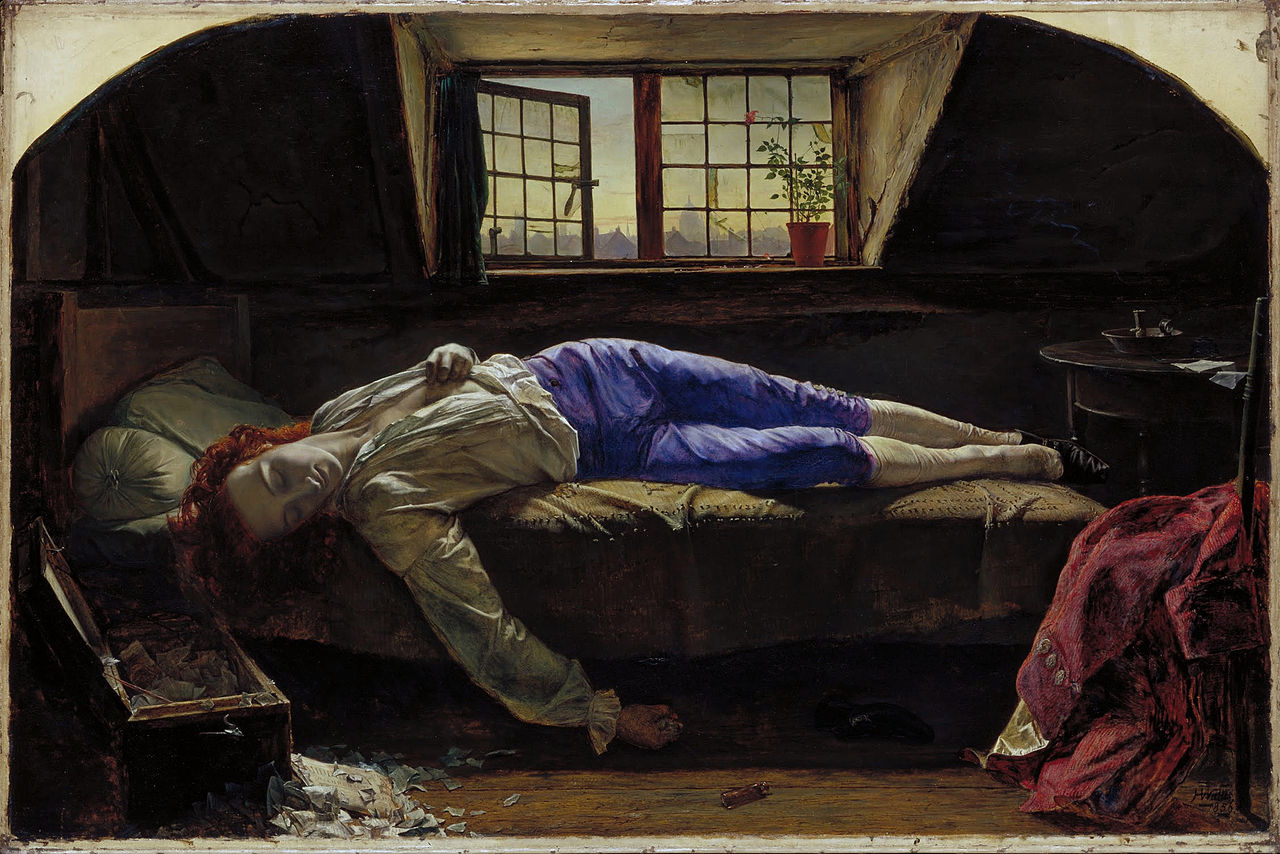
Thomas Chatterton was 17 when he died in a London garret in 1770, poisoned by arsenic, in debt and unrecognised. He had spent his short life forging medieval poetry under the name of a fictional 15th-century monk, Thomas Rowley — and the Victorians, who loved a beautiful corpse and a misunderstood genius, made him their patron saint of wasted talent. Henry Wallis, just 25, painted the scene in 1856: the boy sprawled across his bed in the dawn light, the candle guttered out, his forged manuscripts torn and scattered on the floor.
The model was the young poet and novelist George Meredith, then 28, who posed lying on a bed in Wallis's studio while the painter worked out the fall of the light. Everything in the picture is a clue to the story: the half-written verses, the phial on the windowsill, the Bible open beside the bed. When it was exhibited at the Royal Academy in 1856 it was an immediate sensation — the public queued to see it, and the image of the dead boy in the garret became one of the most reproduced pictures of the century.
It is not, strictly, a Pre-Raphaelite painting — Wallis was never a member of the Brotherhood — but it is Pre-Raphaelite in everything that mattered: the obsessive truth to nature, the literary subject, the moralising symbolism, the beautiful young corpse. Chatterton's death had been a footnote for eighty years; Wallis made it the defining image of Romantic genius cut short.
Frequently asked
Who was Thomas Chatterton?
A Bristol poet who died in 1770 aged 17. He forged medieval poetry under the name of a fictional 15th-century monk, Thomas Rowley, and was exposed as a fraud before his death — then adopted by the Romantics and Victorians as the archetype of the misunderstood genius.
Who modelled for the dead Chatterton?
The young poet and novelist George Meredith, then 28, who posed lying on a bed in Wallis's studio. Meredith went on to become one of the great Victorian novelists, author of The Egoist.
Where is The Death of Chatterton?
Tate Britain, London, where it has been one of the collection's most popular pictures since the 19th century.
Why it matters today
The Death of Chatterton made the dead young genius the Pre-Raphaelites' favourite subject — the image of talent destroyed by an indifferent world echoes through Victorian art, from Millais' Ophelia to the cult of Keats.
More in Art & Painters
All →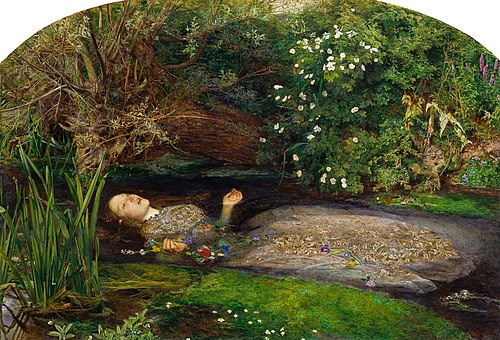
Ophelia
A drowned Shakespearean heroine, painted leaf by leaf on a Surrey riverbank — the image that made the Pre-Raphaelites immortal.

The Lady of Shalott
Tennyson's cursed weaver, caught at the moment she turns to look at Camelot — the most reproduced Victorian painting of them all.

Flaming June
A sleeping woman wrapped in translucent orange silk — the single most famous image of the Aesthetic movement, lost and found again.