The Blind Girl
John Everett Millais

📌 Pin it
Two girls, presumed sisters, rest by a roadside near Winchelsea after a rainstorm. One is blind: a concertina on her lap, a sign reading 'Pity the Blind' around her neck, her face turned up to feel the sun on her skin and the grass under her fingers. Her sighted sister gazes at a double rainbow arcing over the landscape — a beauty the blind girl will never see, and does not know she is missing.
Millais painted the landscape around Winchelsea in 1854 and finished the figures in 1856, working with his usual Pre-Raphaelite exactness: every blade of grass, every raindrop on a leaf. After the exhibition, critics pointed out that a secondary rainbow reverses the colour order of the first — and Millais, to his credit, repainted it for scientific accuracy. A tortoiseshell butterfly rests on the blind girl's shawl, proof of her perfect stillness.
The model for the blind girl was Matilda Proudfoot, a poor girl recruited from a school of industry — she was not herself blind, and Millais first used his wife Effie for the face. The picture's power does not depend on that: it is a study in sympathy, asking the viewer to hold two experiences of the same world at once, and to feel the gap between them.
Frequently asked
What is the story of The Blind Girl?
Two beggar girls rest after a rainstorm near Winchelsea: the blind girl, concertina on her lap, feels the sun and grass, while her sighted sister watches a double rainbow she cannot see.
Was the model really blind?
No — the model was Matilda Proudfoot, a poor girl from a school of industry who was not blind; Millais first used his wife Effie for the face.
Where is The Blind Girl?
Birmingham Museum and Art Gallery.
Why it matters today
The Blind Girl made sympathy itself a subject for art — and its rainbow, corrected after criticism, is a small monument to getting the facts right.
More in Art & Painters
All →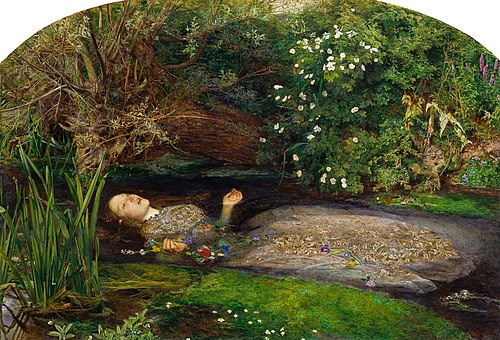
Ophelia
A drowned Shakespearean heroine, painted leaf by leaf on a Surrey riverbank — the image that made the Pre-Raphaelites immortal.

The Lady of Shalott
Tennyson's cursed weaver, caught at the moment she turns to look at Camelot — the most reproduced Victorian painting of them all.

Flaming June
A sleeping woman wrapped in translucent orange silk — the single most famous image of the Aesthetic movement, lost and found again.