Proserpine
Dante Gabriel Rossetti

📌 Pin it
Proserpine, the Roman goddess of spring, was carried off by Pluto to be queen of the underworld. She ate six pomegranate seeds — and because she had eaten the food of the dead, she was condemned to spend six months of every year below ground. Rossetti painted her in a gloomy corridor of her palace, holding the fatal fruit, her face lit by a cold light from a grate. The model was Jane Morris, the wife of his friend and colleague William Morris — and Rossetti's lover.
Rossetti worked on the subject for seven years and painted at least eight versions between 1871 and 1882, the year of his death. The best-known version, inscribed and dated 1874, was commissioned by the Liverpool shipowner Frederick Richards Leyland. Rossetti designed the frame himself, with roundels that echo the sliced pomegranate in her hand, and wrote a sonnet for the picture — 'Afar the flowers of Enna from this drear / Dire fruit, which, tasted once, must thrall me here.' The painting is a portrait of a woman trapped by a choice she cannot undo, and everyone who saw it knew Rossetti was painting Jane's situation as much as the goddess's.
It is the definitive image of the Pre-Raphaelite femme fatale: not a seductress, but a captive. Jane's heavy-lidded gaze, her long neck, her mass of dark hair against pale skin became the visual ideal of the movement's last phase — and the pomegranate in her hand became the shorthand for temptation, captivity and the price of desire.
Frequently asked
What is the pomegranate in Proserpine?
The fruit that condemned her: having eaten six pomegranate seeds in the underworld, Proserpine must spend six months of every year below ground. The pomegranate's red flesh matches the red of her lips — temptation and captivity in one object.
Who was the model for Proserpine?
Jane Morris, the wife of William Morris and Rossetti's lover. Rossetti saw her as a captive goddess — trapped in an unhappy marriage, as Proserpine was trapped in the underworld.
Where is Rossetti's Proserpine?
The best-known version, dated 1874, is at Tate Britain, London. A very similar final version, completed in 1882, is at the Birmingham Museum and Art Gallery.
Why it matters today
Proserpine fixed Jane Morris's face as the Pre-Raphaelite ideal and made the pomegranate the enduring shorthand for temptation and captivity — the image is still reproduced whenever the myth is told.
More in Art & Painters
All →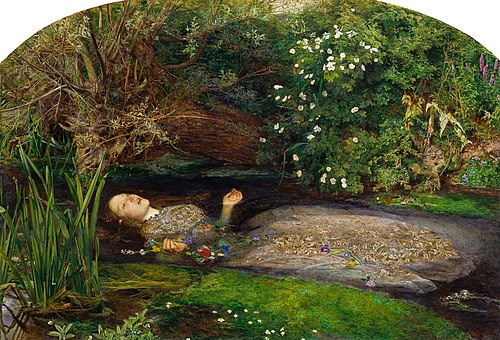
Ophelia
A drowned Shakespearean heroine, painted leaf by leaf on a Surrey riverbank — the image that made the Pre-Raphaelites immortal.

The Lady of Shalott
Tennyson's cursed weaver, caught at the moment she turns to look at Camelot — the most reproduced Victorian painting of them all.

Flaming June
A sleeping woman wrapped in translucent orange silk — the single most famous image of the Aesthetic movement, lost and found again.