Young Lady in a Boat
James Tissot

📌 Pin it
James Tissot — Jacques-Joseph to his French family — was the great society painter of the Victorian age, and Young Lady in a Boat shows why. The subject wears the costume of the French Directoire of the 1790s, all striped silk and broad-brimmed hat; her fan droops at her side, and she meets the viewer's gaze with an impatience one contemporary critic read as barely concealed annoyance at being kept waiting.
A version was shown at the Paris Salon of 1870, among Tissot's last exhibits in France before the Franco-Prussian War drove him to London. There he became the most commercially successful painter of high-society life in England — the man who taught the Victorians how their own drawing rooms looked.
Tissot's women are never ornaments. Beneath the exquisite costume-painting — the striped gown, the ribbons, the fan — is a thoroughly modern psychological portrait: a woman with an interior life, dressed in history but living in the present.
Frequently asked
Who was James Tissot?
Jacques-Joseph Tissot (1836–1902), the French painter who fled to London after the Franco-Prussian War and became Victorian England's great society portraitist — and later the painter of a famous 700-watercolour Life of Christ series.
Why is she dressed in old-fashioned clothes?
Tissot adored 1790s Directoire costume for its elegance — striped silks, broad-brimmed hats, high waists — and used it as a vehicle for thoroughly modern psychological portraits.
Where is Young Lady in a Boat?
In a private collection.
Why it matters today
Tissot's society pictures are the definitive visual record of fashionable Victorian life — the 1870s, painted in oils.
More in Art & Painters
All →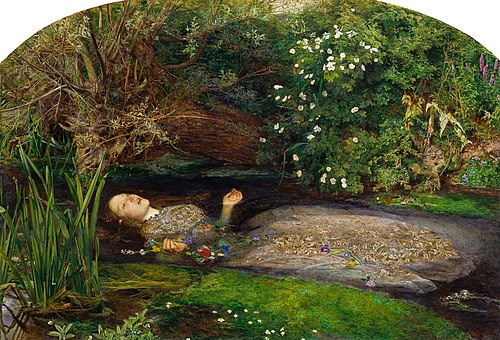
Ophelia
A drowned Shakespearean heroine, painted leaf by leaf on a Surrey riverbank — the image that made the Pre-Raphaelites immortal.

The Lady of Shalott
Tennyson's cursed weaver, caught at the moment she turns to look at Camelot — the most reproduced Victorian painting of them all.

Flaming June
A sleeping woman wrapped in translucent orange silk — the single most famous image of the Aesthetic movement, lost and found again.