The Golden Stairs
Edward Burne-Jones

📌 Pin it
Seventeen young women in classical draperies of gold, silver and ivory descend a winding marble staircase, carrying instruments they barely play. Nothing happens; nothing is explained. When Edward Burne-Jones exhibited The Golden Stairs at the Grosvenor Gallery in 1880 — the Aesthetes' rival to the Royal Academy — that was precisely the provocation.
Burne-Jones, William Morris's closest friend and the second generation's great Pre-Raphaelite, had moved beyond narrative entirely. The models were drawn from fashionable London circles; the staircase itself is an architectural fantasy. Critics who demanded a subject were told, in effect, that the subject was beauty.
The painting became the defining image of the Grosvenor Gallery years — the moment English art declared independence from storytelling. Its flowing lines and flattened rhythms point directly toward Art Nouveau.
Frequently asked
What is the story behind The Golden Stairs?
There isn't one — that is the point. Burne-Jones offered no narrative, no myth, no moral: the painting is a manifesto for beauty as its own subject.
Who are the women in The Golden Stairs?
Seventeen models drawn from fashionable London circles, robed as classical musicians on a fantasy staircase.
Where is The Golden Stairs?
Tate Britain, London.
Why it matters today
The Golden Stairs is the purest manifesto of Aestheticism in paint — and a direct ancestor of Art Nouveau's flowing line.
More in Art & Painters
All →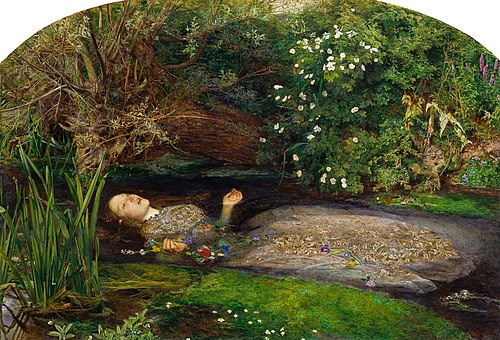
Ophelia
A drowned Shakespearean heroine, painted leaf by leaf on a Surrey riverbank — the image that made the Pre-Raphaelites immortal.

The Lady of Shalott
Tennyson's cursed weaver, caught at the moment she turns to look at Camelot — the most reproduced Victorian painting of them all.

Flaming June
A sleeping woman wrapped in translucent orange silk — the single most famous image of the Aesthetic movement, lost and found again.