The Light of the World
William Holman Hunt

📌 Pin it
William Holman Hunt, the most devoutly Pre-Raphaelite of the Brotherhood's founders, painted Christ at night in a real orchard, working by lamplight to get the darkness right. The figure carries a lantern and knocks at an overgrown door — and the door has no handle. As Hunt explained, it is the door of the human soul: it can only be opened from within.
Exhibited in 1854, the painting puzzled some critics and enraptured the public. Its power was symbolic rather than narrative — a new kind of religious art for an age of doubt, painted with the Brotherhood's fanatical attention to natural detail: every weed, rusted nail and dewdrop observed from life.
The engraved reproduction became one of the best-selling prints of the century, hanging in churches, schools and parlours across the empire. Hunt later painted a larger version (1900–1904) that toured the world — Canada, South Africa, Australia, New Zealand — and now hangs in St Paul's Cathedral. The original belongs to Keble College, Oxford.
Frequently asked
What does the door without a handle mean in The Light of the World?
Hunt explained it himself: the door is the human soul, and it has no handle on the outside because it can only be opened from within.
Where is the original Light of the World?
Keble College, Oxford. Hunt's later, larger version (1900–1904) hangs in St Paul's Cathedral, London.
Why did Hunt paint it at night?
For truth to nature — the founding Pre-Raphaelite principle. He worked outdoors in a real orchard by lamplight so the darkness itself would be observed, not invented.
Why it matters today
The image made religious symbolism modern — the handleless door remains a universal metaphor for the closed heart.
More in Art & Painters
All →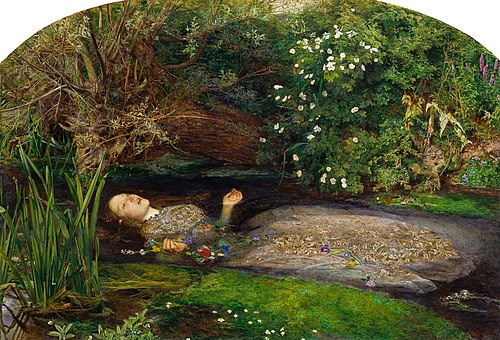
Ophelia
A drowned Shakespearean heroine, painted leaf by leaf on a Surrey riverbank — the image that made the Pre-Raphaelites immortal.

The Lady of Shalott
Tennyson's cursed weaver, caught at the moment she turns to look at Camelot — the most reproduced Victorian painting of them all.

Flaming June
A sleeping woman wrapped in translucent orange silk — the single most famous image of the Aesthetic movement, lost and found again.